
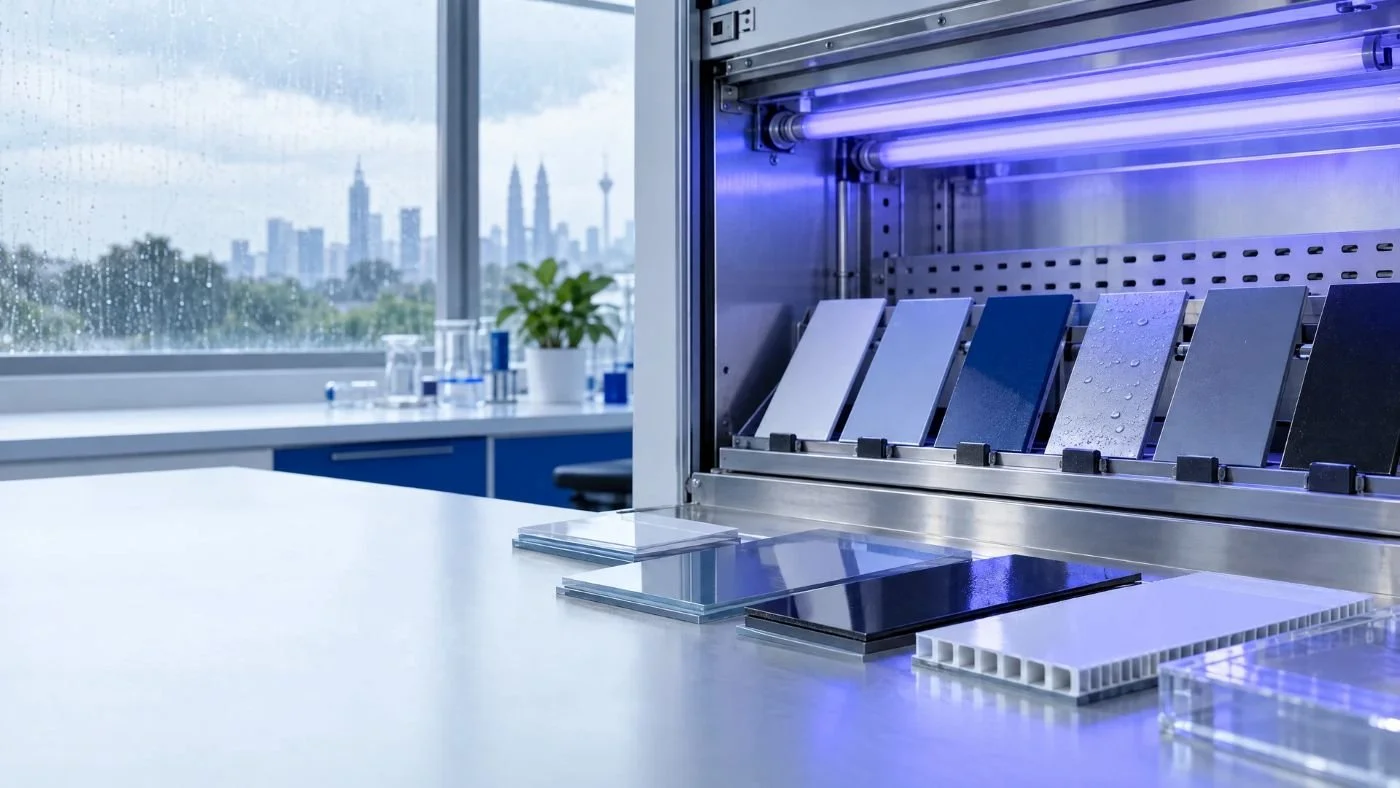
“THE SHORT ANSWER:
No fixed number of chamber hours equals one outdoor year.”
There is no simple conversion. Learn how exposure conditions, specimen setup, and material differences shape accelerated weathering results.
There is no universal number of hours in a UV weathering chamber that equals one year outdoors. A figure such as “1,000 chamber hours equals one outdoor year” may sound useful, but it is not a reliable rule for every material, test cycle, or exposure location. The weathering-correlation technical bulletin explains why one conversion factor cannot account for the many variables that affect outdoor weathering. [1]
That does not make accelerated weathering tests unhelpful. They can provide valuable, controlled comparisons between materials and product formulations. The key is to interpret results as evidence about performance under specified test conditions—not as a guaranteed forecast of exact outdoor service life.
01 / CONTEXT
Why can’t chamber hours be converted into outdoor years?
A laboratory chamber can hold a selected cycle of light, temperature, and moisture. Outdoor exposure is less consistent. Sunlight and weather change with location, season, orientation, local surroundings, and year-to-year conditions. The material itself also affects how it responds.
For manufacturers in Penang, Selangor, Johor, and Kuala Lumpur, “one year outdoors” should refer to a defined use environment. A useful comparison starts by identifying the intended field site and how the product will be installed, including its direction, mounting, shelter, and exposure to rain.
Location and weather
Latitude, altitude, nearby water, wind, shade, and seasonal or annual variation can change exposure conditions.
Specimen mounting
Orientation, angle, backing, and insulation affect the exposure a specimen receives.
Light spectrum
Total light energy is not the only consideration. Wavelength distribution and a material’s sensitivity to it influence degradation.
Moisture and temperature
Condensation, water spray, wetness duration, and temperature can change how quickly and in what way a material degrades.
Material and formulation
Plastics, coatings, automotive components, and other materials do not respond identically to the same exposure.
These variables are why exposure time or total light energy cannot, on its own, establish a universal outdoor-life equivalent. For additional background, see the weathering-correlation technical bulletin.
02 / EXPOSURE CONDITIONS
What do UV, heat, condensation, and spray contribute?
A UV weathering test combines conditions selected for a material and test method. The exposure cycle matters as much as the total duration, so record the settings and phases that make up the programme.
UV radiation
The lamp type and irradiance shape the ultraviolet exposure applied to the specimen. Select them according to the required method and the degradation being studied.
Temperature
Temperature can affect the rate and type of material change. Document the selected setting alongside the exposure cycle.
Condensation
A controlled humid phase can represent selected wetness conditions. The duration and sequence should follow the applicable method.
Water spray
A spray phase can be used when the required cycle calls for surface wetting. Record when it occurs and how it fits into the programme.
ASTM G154-23 describes fluorescent UV apparatus operation and emphasizes reporting the specific exposure conditions. For plastics, ISO 4892-3:2024 specifies exposure methods using fluorescent UV radiation, heat, and water. Confirm the current method and edition that apply to the product being tested.
03 / INTERPRETATION
What does an accelerated UV weathering test tell you?
A well-designed test can help a laboratory compare materials under the same controlled exposure. A manufacturer may use it to screen alternative formulations, compare suppliers, or identify which specimens show a chosen change sooner under a specified cycle.
Ask which material performed better under the defined test conditions—not how many exact service years the result guarantees.
Comparative data can support product development and quality decisions. It does not automatically answer how many years a product will last outdoors. The weathering-correlation technical bulletin distinguishes relative material ranking from an absolute service-life prediction.
ASTM G154-23 says results should be accompanied by the specific operating conditions and recommends using reference materials for comparison. Its practice does not specify the exposure conditions best suited to every material.
04 / FIELD CORRELATION
Can a laboratory create its own rule of thumb?
A laboratory can develop an empirical relationship for a narrowly defined use case, but it should not treat that result as a general conversion factor. Any such relationship is limited to the specific material, lab cycle and temperature, outdoor location, and sample mounting procedure used to develop it. Read the weathering-correlation technical bulletin for further background.
- 1
Define the question. Identify the material, intended application, exposure conditions, and property or failure criterion to assess.
- 2
Choose the test cycle. Record the lamp type, irradiance, temperature, light and moisture phases, and total duration.
- 3
Include references. Use materials with known performance as controls. ASTM G154 recommends at least three replicates of each material for statistical evaluation. See ASTM G154-23.
- 4
Pair lab and field exposure. Where relevant, expose comparable specimens outdoors at the intended site using documented orientation and mounting.
- 5
State the limits. Keep any conclusion specific to the material, cycle, site, and setup tested.
The goal is to use repeatable laboratory results to make better material decisions, then support those decisions with field data when the application calls for it.
05 / EQUIPMENT SELECTION
Choose a UV weathering chamber around the test method
Start with the material and the test requirement, not a target number of “outdoor years.” Confirm the applicable standard or customer method, specimen dimensions, lamp type, irradiance, temperature, and moisture cycle. Also decide which material changes the test needs to measure.
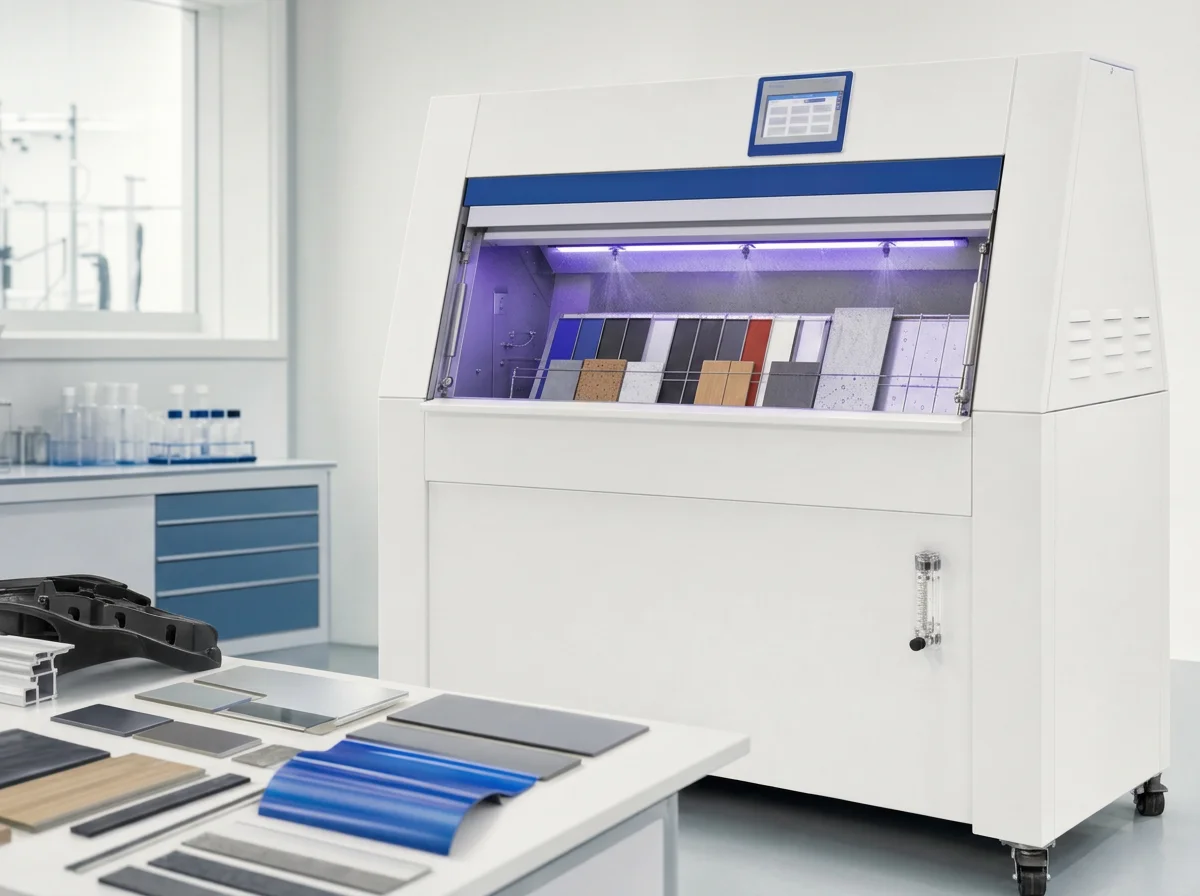
The Testlabs UV Weathering Chamber page lists fluorescent lamp options, irradiance and temperature control, condensation, and water spray. The product page notes that the right exposure cycle depends on the material and required method; listed chamber capabilities should not be treated as blanket compliance with every standard.
When requesting a quotation, share the material, sample dimensions, required test method, lamp preference, and exposure cycle. Those details help frame the chamber configuration around your programme.
View the UV Weathering ChamberFor a quotation or configuration discussion, email sales@testlabs.my.
06 / FAQ
Frequently asked questions
How many hours in a UV weathering chamber equal one year outdoors?
There is no fixed number that applies to all materials, test cycles, and outdoor sites. Any estimate should be supported by a defined, material-specific comparison programme.
Does 1,000 hours in a UV chamber mean the product will last one year outside?
No. Chamber duration alone cannot guarantee a particular outdoor service life. Interpret results alongside the test method, exposure conditions, material, field environment, and evaluation criteria.
What is accelerated weathering testing best used for?
It is useful for comparing materials or formulations under defined laboratory conditions. It can support screening and quality decisions, but should not be presented as a guaranteed calendar-life prediction.
What information should I share when selecting a chamber?
Share the material, specimen dimensions, required standard or customer method, lamp preference, exposure cycle, and the properties you need to evaluate.
Need help with a UV weathering chamber requirement? Email sales@testlabs.my.
