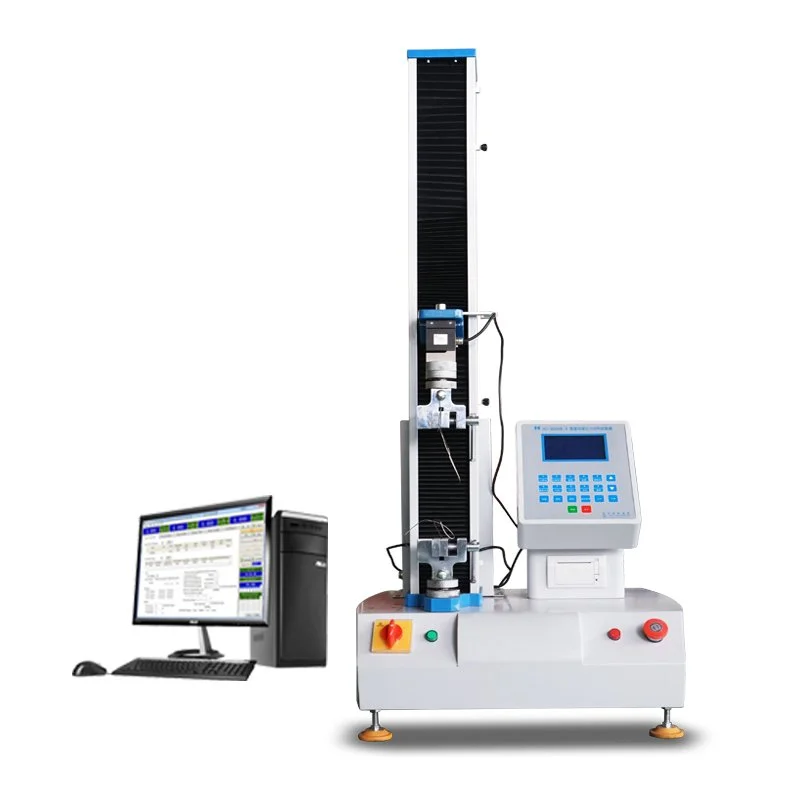
Single Column Universal Testing Machine

Single-Column Universal Testing Machine

TestLabs Malaysia supplies configurable single-column universal testing machines for low-to-medium-force tensile, elongation, peel, tear, puncture, adhesion, pull-out and compression testing, with capacity, travel, fixtures and software selected for the specimen and method.

✳︎

Local Technical Support

✳︎

1 Year Local Warranty

✳︎

Free Training

✳︎ Local Technical Support ✳︎ 1 Year Local Warranty ✳︎ Free Training

Select the right force, travel and fixture for your material—not just a machine label. TestLabs Malaysia helps configure Haida single-column universal testing equipment for tensile, elongation, peel, tear, puncture, adhesion, pull-out and compression work on films, flexible packaging, paper, plastics, rubber, textiles, leather, tapes and selected medical materials.

  • Configurable force classes: commonly 5–200 kg, with a long-stroke option reported up to 5–500 kg; final load cell and usable range require quotation confirmation.

  • Speed options: approximately 0.1–500 mm/min on newer servo configurations; other pages state 50–300 mm/min.

  • Travel options: approximately 700–900 mm on compact platforms and up to 1,500 mm including clamp on the long-stroke family, depending on configuration.

  • Application-led fixtures: tensile, peel, tear, puncture, compression, bending, adhesive and pull-out fixtures can be specified where compatible.

A practical single-column platform for flexible and smaller specimens

The Single-Column Universal Testing Machine is a configurable material-testing platform for laboratories, quality teams, converters, manufacturers and research users who need controlled force measurement in a compact frame. Depending on the selected configuration, it can support tensile and elongation work as well as peel, tear, puncture, adhesive-strength, pull-out, compression or bending tests.

It is a strong starting point for paper and board strips, plastic film, flexible packaging, labels, adhesive tape, release/protective film, non-woven materials, rubber, yarn, fibre, leather, hose sections and selected medical-material or component tests. Application lists include film, soft packaging, tape/adhesive, paper, rubber, non-woven, foil, medical adhesive/device and related puncture or peel work.

For specimens that extend substantially or need more vertical space, TestLabs can quote a long-stroke single-column configuration. For a larger, heavier or more rigid specimen, compare this page with the Double-Column Universal Testing Machine.
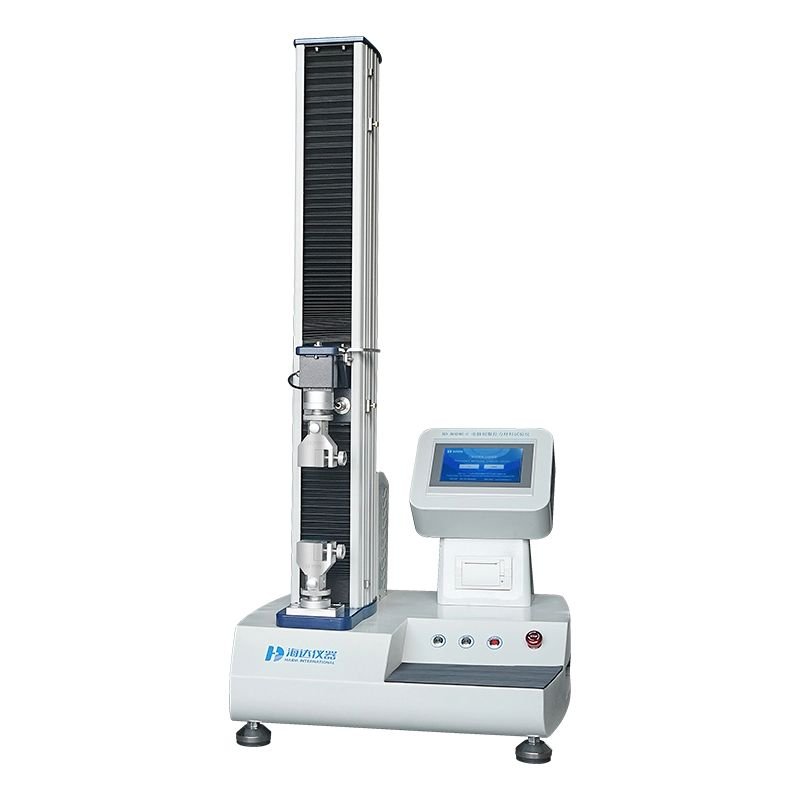
practical single-column tensile machine for flexible and smaller specimens
HD-B609B-S Technical Specifications
HD-B609B-S Universal Testing Machine — Technical Specifications
Specification HD-B609B-S
Model HD-B609B-S
Load capacity 5–200 kg
Load cell Germany brand TECSIS load cell
Motor 400 W Panasonic servo motor
Driver 400 W Panasonic servo driver
Screw High-precision ball screw
Control method Panel control with touch screen, connected to a computer
Adjustable speed 0.1–500 mm/min
Vertical test space 900 mm, including clamp
Load resolution 1/250,000
Load accuracy ≤0.5%
Unit switching gf / kgf / N / kN / lbf / T
Dimensions (L × W × H) 520 × 515 × 1,250 mm
Approximate machine weight About 70 kg
Power AC 220 V

What is included and what is optional

Typically quoted as part of a configured system

•Single-column test frame and actuator selected for the required force class.

•Load cell matched to the expected force range.

•Basic controller or PC/servo control, as stated in the quotation.

•A primary tensile grip or clamp selected for the specimen.

•Operating documentation and installation/commissioning scope, where included by TestLabs/Haida quotation.

Optional or method-dependent

•Additional tensile jaws for films, paper, yarn, fibre, wire, hose, rubber or other geometry.

•Peel, tear, puncture, adhesive-strength, pull-out, compression or bending fixtures.

•Extensometer or other elongation measurement device.

•Built-in printer, Lenovo/Windows PC, TM2101 or other software, data export and network/RS232/USB interface.

•Environmental chamber or temperature-conditioned testing configuration.

•Custom grips for medical components, seals, tapes, cable, textile or irregular specimens.

•Calibration, verification, method development, operator training and site safety accessories.

Industry applications

Polymer, plastics, rubber and flexible materials

Use the single-column platform for tensile, elongation, tear, peel, bond or compression work on plastic film, plastic hose sections, rubber, non-woven material, PVC/PC/PB-type materials, composites, nylon/fabric and other flexible specimens where the force and grip geometry fit. A 5–200 kg configuration is a sensible starting point for many films, tapes and small specimens; a long-stroke configuration may be more appropriate for extensible rubber, hose, textile or larger polymer specimens.

Packaging, paper and converting

The machine can be configured for paper, board, film, flexible packaging, labels, release paper, adhesive tape, bags and related material strips. Typical requested outputs may include maximum force, elongation, break force, peel force, tear force or seal/adhesive strength, depending on the fixture and method.

Medical and pharmaceutical materials/components

A configured single-column machine may suit component-level testing of medical films, patches, adhesive layers, seals, rubber materials, tubing sections or other materials when the force range, fixture and method are appropriate.

Electronics, electrical, semiconductor and battery-related materials

The machine may be relevant to mechanical testing of films, foil, insulation, adhesive tape, wire/cable or small component materials.

Automotive materials and small components

Use a generic single-column system only for appropriately sized material coupons, films, rubber, adhesive, wire/cable or small polymer components.

When to choose this product

Choose the Single-Column Universal Testing Machine when the work is mainly film, paper, labels, tape, flexible packaging, rubber, textile, leather, non-woven or smaller medical-material specimens; when expected force is normally in the 5–200 kg class or a long-stroke configuration up to the reported 5–500 kg class is suitable; and when compact footprint is a priority.

For larger, wider, heavier or more rigid specimens, higher force, greater span, hydraulic clamping or demanding compression/bending/shear fixtures, link to the Double-Column Universal Testing Machine. Do not choose by industry name alone. Choose from specimen, maximum force, dimensions, speed, method and fixture requirements.

Localized Support for Malaysia's Industrial Hubs

We provide direct equipment sales, technical supply, and rapid on-site maintenance for specialized industries across Malaysia:
•       Penang: Semiconductor labs and microelectronics wafer fabrication facilities requiring precise steady-state climate chambers.
•       Selangor: Automotive component testing and industrial manufacturing QA facilities needing programmable environmental chambers.
•       Johor: Heavy manufacturing and electronics assembly hubs demanding reliable temperature humidity testing equipment.
•       Kuala Lumpur: Centralized R&D and compliance testing laboratories.

Single-Column Universal Testing Machine FAQs

Single-Column Universal Testing Machine FAQs

What is a single-column universal testing machine used for?

A single-column universal testing machine applies controlled force to measure properties such as tensile strength, elongation, peel force, tear force, puncture force, adhesive strength, pull-out force, compression or bending. The exact test depends on the load cell, fixture, travel, measurement system and method configuration.

Should I choose a single-column or double-column machine?

Choose the single-column configuration for many lower-to-medium-force film, paper, tape, polymer, rubber, textile and smaller medical-material tests. Choose the double-column configuration when the specimen is larger, wider, heavier, more rigid or requires higher force, larger span, compression/bending/shear fixtures or hydraulic clamping. TestLabs can confirm the selection from your specimen details.

Can the machine test plastics, rubber and polymer materials?

Yes, a suitable configuration may test plastic films, hose sections, rubber, non-woven materials, tapes, packaging and other polymer specimens. The correct load cell, grip, travel, speed and method must be confirmed for the particular specimen.

Can it test paper and packaging?

Yes, configurations can be specified for paper, board, film, flexible packaging, labels, tapes and related materials. Carton, drum, burst, drop, vibration or compression programs may require additional dedicated packaging equipment rather than a tensile test alone.

Can it test medical materials or devices?

It may test selected medical films, patches, seals, tubing or component materials when the force range, fixture and method are suitable. A generic universal tester is not automatically a medical-device, pharmaceutical, cleanroom or regulatory-compliance system. Dedicated needle or catheter methods may require dedicated instruments.

Can it test automotive, electronics or battery products?

It may support mechanical testing of suitable material coupons, films, adhesives, cable, wire, plastics or selected components. It does not automatically perform complete automotive qualification, electrical safety, battery abuse, semiconductor reliability or other specialised tests. Confirm the customer’s exact method and scope.

Which standards does it support?

Haida source pages cite ASTM, ISO, JIS, BS/BS EN, EN, SAE, FTM and other references, including examples such as ASTM D882, ASTM D638/ISO 527-1/2, ASTM D3330, ASTM D624, ISO 178/ASTM D790 and ASTM D659. Exact standard edition, fixture, speed, specimen preparation, extensometer, calibration and report scope must be confirmed for the selected configuration. A listed reference is not a blanket certification claim.

Are grips and software included?

They depend on the configuration and quotation. Some Haida pages list tensile clamps, PC/software, printer, extensometer or manuals, while other pages do not. Send a specimen drawing and required method so TestLabs can provide a written inclusion schedule.

What information should I send for a quotation?

Send the material/product, specimen dimensions, expected force, test type, speed, standard or internal method, required travel, fixture details, temperature/conditioning, power, location and data-output requirements. A photo, drawing or sample is highly useful.

Need help selecting the appropriate capacity or fixture? Email sales@testlabs.my or call/WhatsApp +60 18-203 0306.

Industries We Serve

Electronics & Semiconductors

Test circuit boards, microchips, and electronic components for thermal stress resistance. Ensure products survive extreme temperature transitions in real-world conditions.

Automotive & Aerospace

Validate critical components like sensors, connectors, and batteries for thermal durability. Comply with automotive and aerospace testing standards for safety-critical applications.

Pharmaceutical & Chemical

Test medication stability, chemical formulations, and packaging materials under extreme conditions. Ensure product integrity and shelf-life compliance.

Materials & Manufacturing

Evaluate composite materials, plastics, rubber, and metals for thermal expansion effects. Support product improvement and quality assurance processes.

Research & Development

Universities, testing laboratories, and R&D facilities use thermal shock chambers for material science research and product development validation.

Request a Quotation

Contact us today to explore comprehensive testing solutions tailored to your organization's needs.