
Universal Hardness Testers in Malaysia
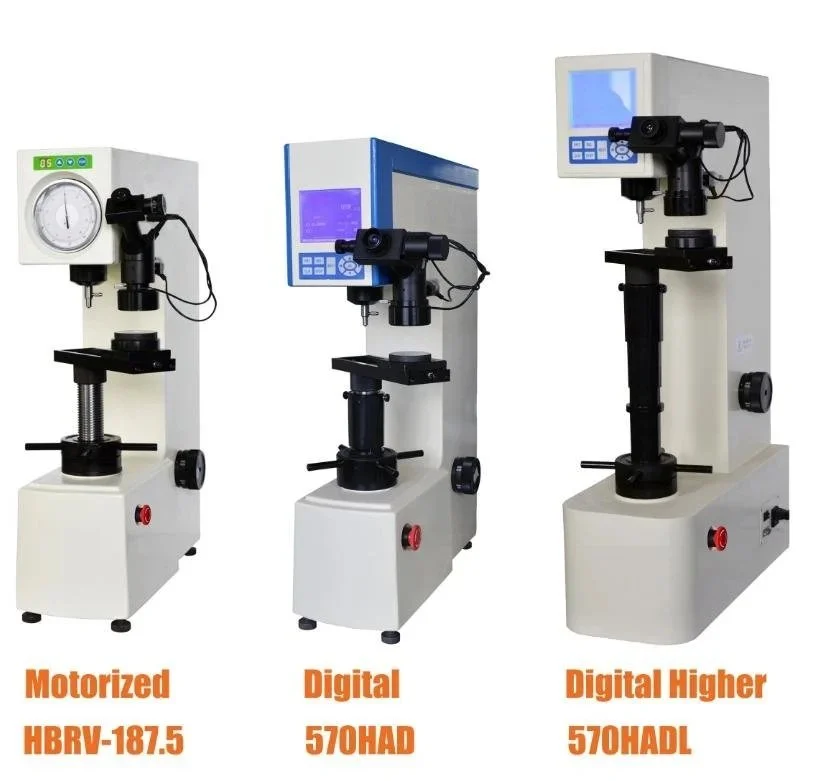
A universal hardness tester combines more than one indentation test method on one machine. In the supplied VTS brochure, “universal” means Brinell, Rockwell and Vickers modes. The brochure lists three models: motorized HBRV-187.5, digital 570HAD and higher-test-space 570HADL. Test force, indenter, scale and maximum specimen height depend on the selected method and model. TestLabs can help compare the options using your material, test methods and largest sample. Inquiries are welcome from Penang, Selangor, Johor and Kuala Lumpur.
✳︎
Local Technical Support
✳︎
1 Year Local Warranty
✳︎
Free Training
✳︎ Local Technical Support ✳︎ 1 Year Local Warranty ✳︎ Free Training
Three methods, one tester platform
Brinell, Rockwell and Vickers: What Changes?
The method determines the indenter, force and reading process. A multi-method instrument is useful only when its available method settings match the test specification.
Rockwell: depth-based reading
Rockwell determines hardness from the permanent depth of penetration under a prescribed sequence of forces. The VTS brochure lists 60, 100 and 150 kgf force settings, Rockwell diamond and 1.588 mm ball indenters, and dial reading on HBRV-187.5 or an LCD on 570HAD/570HADL.
Brinell: ball indentation diameter
A ball is pressed into the specimen and the residual indentation diameter is measured optically. VTS lists Brinell forces of 30, 31.25, 62.5, 100 and 187.5 kgf and 2.5 mm / 5 mm ball indenters for the combined tester.
Vickers: diamond-pyramid impression
A diamond pyramid makes a square impression whose diagonals are measured optically. The brochure lists 30 and 100 kgf Vickers forces, with 75× magnification. These are not micro-Vickers load settings.
Method selection matters: Rockwell is depth-based, while Brinell and Vickers require optical indentation measurement. The digital model’s scale-conversion function does not replace a test performed on the method and scale specified by a customer or governing procedure.
Application fit
Materials and Applications
The VTS brochure lists steel products, castings, non-ferrous metals and several heat-treated or hardened materials. Select a method and scale for the specific material and specimen geometry.
Hardened and heat-treated steels
The brochure lists hardened or surface-hardened steel, hardening and tempering steel, tempered steel, carburized sheet and surface heat-treated materials. Confirm the required scale and test location.
Castings and non-ferrous metals
Cast parts, non-ferrous metals and soft metals appear in the VTS application list. The suitable method depends on the material, thickness, surface and required test procedure.
One instrument for multiple test methods
Discuss the combined Brinell/Rockwell/Vickers platform when your lab performs more than one method and the listed forces, indenters, readouts and specimen spaces cover the work.
Application caveat: These are examples listed in the brochure, not a promise that every model, method or scale suits every material. A multi-method tester is not automatically a substitute for a dedicated low-load microhardness tester or an instrumented indentation system.
Selection checklist
How to Choose a Universal Hardness Tester
Start from the method and scale required, then verify the sample, working space and reporting workflow.
- List the methods you actually useSpecify Brinell, Rockwell, Vickers or a combination. Do not assume that a “universal” label includes Knoop, micro-Vickers or every scale.
- Check force and scale for each methodMatch the required test forces to the brochure options: Rockwell 60/100/150 kgf; Brinell 30/31.25/62.5/100/187.5 kgf; Vickers 30/100 kgf.
- Measure the largest specimenCompare the part against method-specific maximum height. Choose 570HADL only when its larger vertical test space is needed; its throat remains listed as 165 mm.
- Choose reading and data handlingCompare HBRV-187.5 dial/table reading with the 570HAD/570HADL LCD, built-in printer, result storage, max/min/average and RS-232 features.
- Confirm fixtures, standards and site detailsTell us about part shape, available test locations, V-block/flat support, reporting, relevant standard edition, power supply and delivery location.
If your requirement is Vickers testing below the brochure’s 30 kgf minimum, or micro-Vickers testing, ask for a dedicated model that covers the required low-force range rather than assuming these universal testers will do so.
Request a model recommendation
What to Include in Your Inquiry
Send the information below so TestLabs can assess whether HBRV-187.5, 570HAD or higher-space 570HADL matches your work. Inquiries are welcome from Penang, Selangor, Johor and Kuala Lumpur.
Email your requirements to TestLabsEmail: sales@testlabs.my
- Material and condition, such as cast, heat-treated or hardened
- Required method(s), hardness scale and force for each method
- Applicable test standard and edition or customer procedure
- Largest sample size, height, shape, thickness and approximate weight
- Test locations, surface condition and available clearance
- Need for LCD, data storage, printer, RS-232 or statistical results
- Fixtures, indenter or accessory requirements
- Site power supply and delivery location
Standards and configuration
Standards and Specifications
The brochure lists different standards for each method. Confirm the exact edition and required test procedure against the customer specification before ordering.
- Rockwell
Brochure references ISO 6508, ASTM E18, JIS Z2245 and GB/T 230.2. - Brinell
Brochure references ISO 6506, ASTM E10, JIS Z2243 and GB/T 231.2. - Vickers
Brochure references ISO 6507, ASTM E92, JIS Z2244 and GB/T 4340.2.
Important: A brochure’s standards list is not a blanket certification or compliance claim. The digital models list cross-scale conversions; confirm that a converted value is accepted for the material and governing procedure. Force settings are shown in kgf as listed; confirm the specified units and configuration for your test.
Method references: EMCO-TEST method overview · Rockwell depth method · Vickers optical method · ASTM E92 Vickers scope summary.
Universal Hardness Tester Questions
In the supplied VTS brochure, “universal” refers to a tester with Brinell, Rockwell and Vickers modes. The available loads and sample space still vary by model and method.
What does “universal hardness tester” mean in the VTS brochure?
It describes a combined tester platform with Brinell, Rockwell and Vickers test modes. It does not mean the instrument covers every hardness scale, Knoop testing, micro-Vickers forces or every material and specimen.
What is the difference between Brinell, Rockwell and Vickers testing?
Rockwell determines hardness from permanent indentation depth. Brinell measures the diameter of a ball indentation. Vickers measures the diagonals of a square impression made by a diamond pyramid. Each method has its own force, indenter, scale and specimen requirements.
Which VTS universal hardness tester models are available in the brochure?
The brochure lists HBRV-187.5, a motorized multi-functional tester; 570HAD, a digital universal tester; and 570HADL, a higher-test-space digital model. Confirm current availability and supplied configuration with TestLabs.
What is the difference between 570HAD and 570HADL?
Both are digital Brinell/Rockwell/Vickers models with LCD display, automatic loading/dwell/unloading, printer and RS-232 features listed in the brochure. The 570HADL provides higher method-specific maximum specimen heights: Rockwell 400 mm, Brinell 330 mm and Vickers 345 mm. The brochure lists a 165 mm throat for both.
Can these universal testers perform micro-Vickers testing?
The supplied brochure lists Vickers forces of 30 and 100 kgf for these models. Those settings are not micro-Vickers loads. If your procedure requires lower-force microindentation, ask TestLabs to confirm a tester designed for the required force range.
What force settings are listed for each test method?
The brochure lists Rockwell forces of 60, 100 and 150 kgf; Brinell forces of 30, 31.25, 62.5, 100 and 187.5 kgf; and Vickers forces of 30 and 100 kgf. Match the force with the required indenter, scale and test standard. These are discrete settings.
Which standards are referenced for the three methods?
The brochure references ISO 6508, ASTM E18, JIS Z2245 and GB/T 230.2 for Rockwell; ISO 6506, ASTM E10, JIS Z2243 and GB/T 231.2 for Brinell; and ISO 6507, ASTM E92, JIS Z2244 and GB/T 4340.2 for Vickers. Confirm the applicable edition and the customer’s exact procedure; these brochure references are not a blanket compliance claim.
What information should I include when requesting a quotation?
Include the material and condition, required method and scale, force for each method, applicable standard and edition, sample dimensions and approximate weight, the largest sample height, test locations and surface condition, desired readout/data output, fixtures, site power supply and delivery location.
Localized Support for Malaysia's Industrial Hubs
We provide direct equipment sales, technical supply, and rapid on-site maintenance for specialized industries across Malaysia:
• Penang: Semiconductor labs and microelectronics wafer fabrication facilities requiring precise steady-state climate chambers.
• Selangor: Automotive component testing and industrial manufacturing QA facilities needing programmable environmental chambers.
• Johor: Heavy manufacturing and electronics assembly hubs demanding reliable temperature humidity testing equipment.
• Kuala Lumpur: Centralized R&D and compliance testing laboratories.
Request a Quotation
Email TestLabs with your test methods, required forces and largest specimen dimensions. We will review the VTS model range and confirm the configuration to quote.