
Thermal Shock Testing: Can Your Product Withstand Rapid Temperature Change?
Thermal shock testing exposes a product to rapid transitions between high and low temperatures to identify failures such as cracking, delamination, seal damage, deformation, or loss of function. For battery cells, modules, and packs, a Battery Environmental Test Chamber can provide controlled temperature and humidity exposure with a safety configuration selected for the battery and test risk. The required temperature limits, transfer rate, dwell time, number of cycles, specimen condition, and inspection criteria must be selected from the applicable test method and the product's intended use. TestLabs.my can discuss thermal shock testing requirements and battery environmental chamber options for manufacturers and laboratories in Malaysia.Planning a test or chamber purchase? Email sales@testlabs.my with your product details for an initial review.
What Is Thermal Shock Testing?
Thermal shock testing evaluates how a component, equipment item, material, package, or finished product responds when its surrounding temperature changes rapidly. The test is more severe than ordinary storage or operating exposure because the specimen experiences a short transition between hot and cold conditions. The resulting thermal gradients can reveal weaknesses that may not appear during a slow temperature change.
Typical observations include cracks, delamination, blistering, loss of adhesion, seal or housing damage, distortion, electrical malfunction, and changes in appearance or performance. The actual inspection criteria should be agreed before testing because a pass or fail decision depends on the product requirement and the selected test method.
Why Manufacturers Use Thermal Shock Testing
Manufacturers use thermal shock testing to identify temperature-transition risks before production release, shipment, field deployment, or warranty exposure. It is relevant when a product may move between hot and cold environments, contains materials with different coefficients of expansion, or includes seals, joints, coatings, soldered connections, adhesives, batteries, or electronic assemblies that may respond differently to rapid temperature change.
Possible applications include automotive components, electronic and electrical products, aerospace or defence components, industrial equipment, packaging, plastics, rubber parts, coated materials, battery cells, battery modules, battery packs, and assemblies intended for outdoor or transported service. The suitability of a test should be assessed from the product's risk profile rather than from the industry name alone.
How a Thermal Shock Test Is Planned and Performed
A defensible thermal shock plan starts with the product requirement. The test laboratory or equipment user should document the high and low temperatures, transition or transfer requirement, exposure or dwell time, number of cycles, sample quantity, product orientation, operating state, monitoring points, and post-test inspection. The applicable standard may also specify stabilization, recovery, functional checks, or visual examination.
Temperature limits and transition requirements
Select temperatures that represent the intended environment or the agreed qualification objective. Do not choose a temperature that damages the specimen in a way unrelated to the intended failure mechanism. The transition requirement is method-specific; avoid publishing a universal rate such as “15 °C per minute” unless the exact standard, test method, and product requirement support it.
Dwell time, cycles, and specimen monitoring
Dwell time must allow the specimen or the relevant measurement point to reach the required condition, as defined by the selected method. Cycle count and acceptance criteria should be agreed before the run. Thermocouple placement, specimen spacing, thermal mass, airflow, and the number of samples can affect the result, so the test setup should be recorded in the report.
Powered and unpowered test configurations
Some products are tested unpowered, while others must operate or be monitored during exposure. If the product is powered, plan the chamber feedthrough, cable length, electrical safety, instrumentation, and functional checks before the test. Confirm the chamber's available feedthroughs and monitoring capability during quotation.
Which Standards May Apply?
The relevant standard depends on the product, market, contractual requirement, and failure mechanism. IEC 60068-2-14 describes environmental testing for the ability of components, equipment, or other articles to withstand rapid changes of ambient temperature . The IEC page currently identifies a newer 2023 publication in addition to the 2009 page, so the required edition and test procedure should be confirmed before quotation.
MIL-STD-810 and MIL-STD-202 may appear in customer or defence-related test requirements, but the exact method, procedure, severity, conditioning, and acceptance criteria must be identified. ASTM D6944 is specifically a practice for evaluating the resistance of cured coatings or coating systems to repeated thermal cycles; it should not be presented as a universal thermal shock standard for every product .
2-Zone and 3-Zone Thermal Shock Chambers
A 2-zone chamber normally transfers the specimen between separate hot and cold zones. A 3-zone chamber normally uses hot, cold, and test zones so the specimen can remain in the test area while the air path changes. The exact mechanical design, specimen capacity, recovery performance, temperature range, and control functions vary by model and must be confirmed against the required test profile.
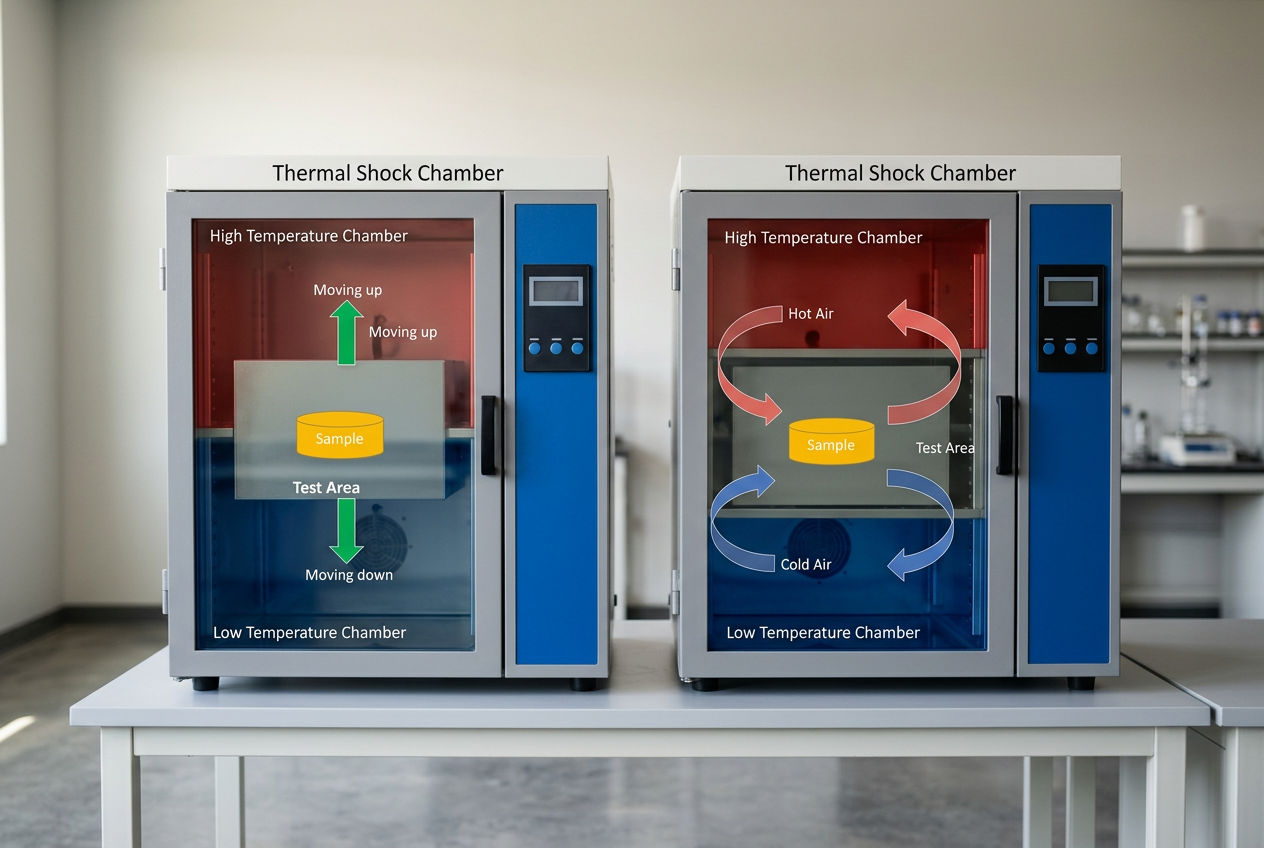
2-zone and 3-zone thermal shock chamber
| Chamber type | How it works | When it may be considered | Quotation details to confirm |
|---|---|---|---|
| 2-zone thermal shock chamber | A basket or elevator transfers the specimen between separate hot and cold zones according to the programmed sequence. | Compact specimens or test plans where transfer between two conditioned zones matches the required method. | Basket dimensions and load, transfer time, temperature range, dwell control, feedthroughs, recovery performance, and safety functions. |
| 3-zone thermal shock chamber | The specimen remains in a test zone while conditioned hot or cold air is directed to it from the respective zone. | Products, parts, or sample sets where a stationary specimen and independent hot/cold air switching are preferred or required. | Test-zone dimensions, sample spacing, airflow, temperature uniformity, switching performance, powered operation, and monitoring points. |
| Air-to-air or liquid-medium design | The chamber uses air or another test medium to create the required thermal exposure. | Selection depends on the product, heat-transfer requirement, applicable method, contamination risk, and laboratory practice. | Medium, specimen compatibility, cleaning, fixture design, transfer requirement, and the exact test method. |
Configuration note: The labels “2-zone” and “3-zone” describe common chamber architectures. Exact performance and available options vary by model. Email sales@testlabs.my with the product dimensions, weight, temperature profile, and required standard before selecting equipment.
Battery Environmental Test Chamber for Thermal Shock and Cycling
A Battery Environmental Test Chamber is used to expose battery cells, modules, or packs to controlled temperature and humidity conditions while the operator monitors the agreed test profile. A battery-focused chamber should be selected from the specimen size and energy level, temperature and humidity requirements, powered or unpowered state, cable and sensor needs, failure scenario, and required safety controls. It is not enough to select a standard environmental chamber by temperature range alone.TestLabs.my's current battery chamber pages present explosion-proof containment and configuration options such as a multi-layer observation window, test cable ports, pressure relief, gas monitoring, fire suppression, temperature probes, and other safety features. The product pages also show multiple chamber volumes and temperature ranges. Treat these as configuration-dependent product information: confirm the exact model, standard versus optional safety components, working volume, temperature range, warranty, calibration, installation, and after-sales scope in the quotation.
