
How to Choose the Right Temperature Humidity or Climatic Test Chamber
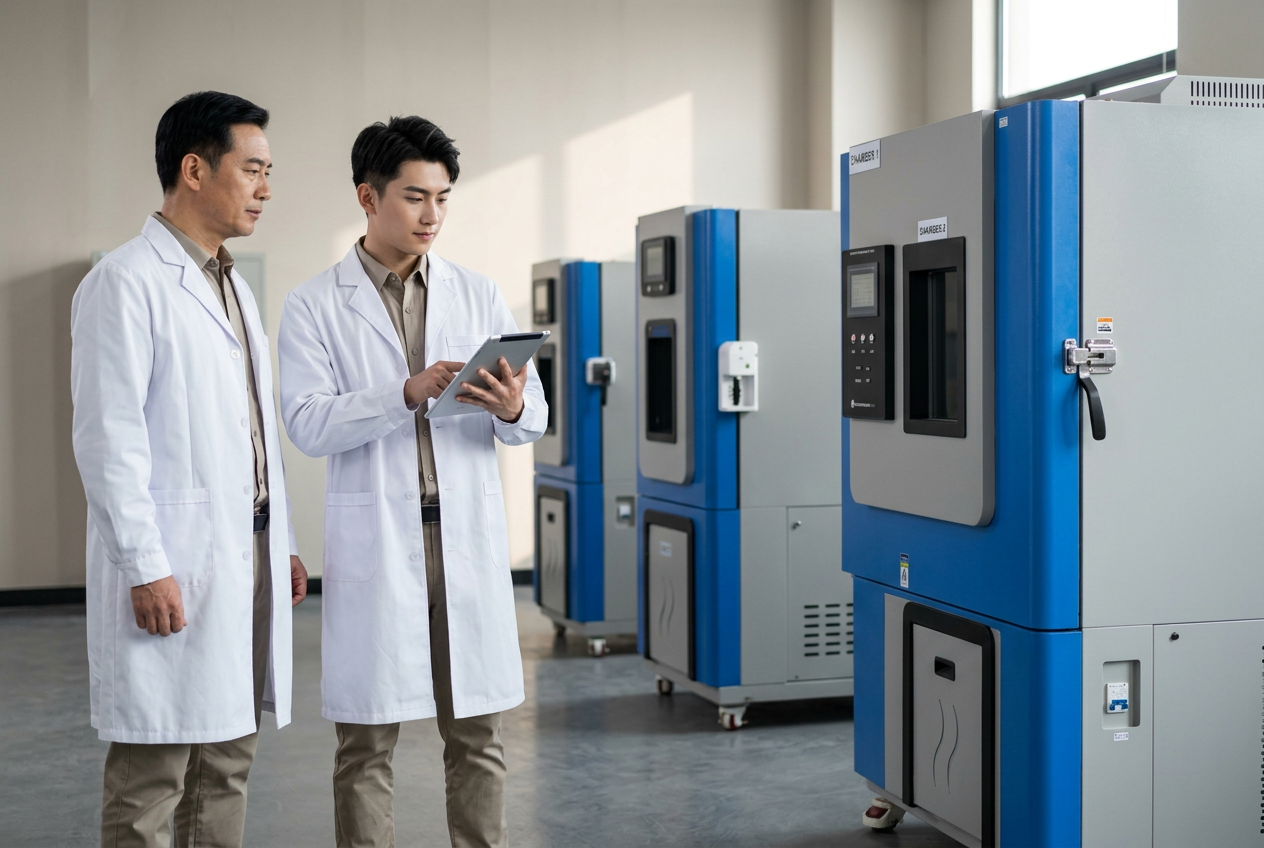
A temperature humidity test chamber, also called a climatic chamber or environmental chamber, is an enclosure that exposes products, materials, components or specimens to controlled temperature and relative humidity conditions. The right chamber is selected from the required test profile, specimen size, load, test method, control accuracy, facility constraints and after-sales support—not from chamber volume alone.
If you are comparing a bench-top, floor-standing or walk-in chamber in Malaysia, start by writing down the test conditions and the largest specimen before requesting a quotation. TestLabs can help match those requirements to a standard or custom temperature humidity chamber for R&D, quality control, reliability testing and production support.
Need a fast recommendation? Email sales@testlabs.my with your product dimensions, approximate weight, required temperature and humidity range and delivery location.
What Is a Temperature Humidity Test Chamber?
A temperature humidity chamber controls temperature and relative humidity around a test specimen for a defined test duration or programmed cycle. A climatic chamber is the broader term often used for the same type of environmental simulation equipment. Depending on the configuration, a chamber may support constant temperature and humidity exposure, temperature cycling, ramp-and-soak profiles, condensation-related testing or other customer-defined environmental test sequences.
A chamber is test equipment. Buying a chamber or receiving a calibration service does not by itself certify a product or prove compliance with a standard. The chamber, sensors, test method, specimen preparation, loading, instrumentation and acceptance criteria must be reviewed against the applicable customer or regulatory requirement.
Start With Your Test Requirements
Product, specimen size and test load
Record the product or material being tested, the largest specimen dimensions, the number of specimens tested at one time, the approximate mass, the fixture or shelf arrangement, and whether the product must operate while inside the chamber. Leave enough space around specimens for airflow and safe door operation. A chamber that is large enough to close may still be unsuitable if the load restricts airflow, blocks sensors or exceeds the shelf rating.
For small components, materials and R&D samples, a bench-top chamber may be the most practical option. For larger parts, multiple specimens or higher-throughput work, a floor-standing chamber may provide a better balance of capacity and footprint. For complete machines, vehicle parts, large assemblies or batch testing, a walk-in chamber may be appropriate. The final selection should be based on the actual test load and the chamber manufacturer's load and uniformity information.
Temperature and relative humidity profile
Define the lowest and highest temperature, the minimum and maximum relative humidity, the dwell time at each condition, the ramp or transition rate, and whether the test is constant, cyclic or combined with another stress. Also record whether the product is powered during testing and whether heat generated by the product must be removed.
TestLabs product pages show different ranges for different chamber configurations. Examples include a 22 L bench-top chamber with a stated temperature range of -40°C to +150°C, standard chamber configurations with published ranges extending from -70°C to +180°C, and walk-in configurations with published options from 0°C, -10°C, -20°C or -40°C to +150°C. Humidity capability also varies by configuration. Treat these values as starting points for discussion, not as a universal specification for every model. The quotation should confirm the guaranteed range, stability, uniformity, ramp rate and operating limits for the selected chamber and test load.
Choose the Chamber Type and Capacity
The following comparison is a practical starting point. It does not replace a load calculation or a model-specific quotation.
| Chamber type | Best suited to | Published TestLabs example | Selection checks |
|---|---|---|---|
| Bench-top | Small components, materials, cosmetics, medical products and R&D or quality-control samples where laboratory space is limited. | 22 L model; published temperature range of -40°C to +150°C and humidity range of 30% to 95% RH. | Confirm internal working dimensions, specimen mass, shelf arrangement, airflow, cable access and whether the product is powered during the test. |
| Floor-standing | Larger products, multiple specimens and routine reliability or production-support testing that does not require a walk-in room. | Published capacity examples include 100 L, 150 L, 225 L, 408 L, 800 L and 1,000 L. A published configuration lists -70°C to +180°C and 10% to 98% RH. | Confirm the selected model's usable volume, door clearance, floor loading, electrical supply, heat rejection, water requirements, uniformity and loaded ramp performance. |
| Walk-in | Complete machines, large assemblies, vehicle parts, large specimens or batch testing where a cabinet is too small. | Published configurable volumes include 2, 4, 8 and up to 40 m³. Published options include 0°C, -10°C, -20°C or -40°C to +150°C and 20% to 95% RH. | Confirm room layout, access route, floor and structural loading, personnel safety, emergency release, ventilation, drainage, power, installation and service access. |
Important: These are published examples, not a universal specification. Final range, stability, uniformity, ramp rate and capacity depend on the selected configuration, test load and applicable method. Request a model-specific technical quotation.
A chamber's nominal volume is only one part of the selection. Check internal working dimensions, shelf loading, cable ports, access clearance, door swing, floor loading, ventilation, water supply or drainage requirements, electrical supply and the space required for service access. For a walk-in room, also check personnel safety, emergency release, lighting, floor construction and the movement path for the largest specimen.
Compare Temperature, Humidity and Control Requirements
Published product information for TestLabs equipment includes configurable features such as programmable control, data logging or computer connection, anti-fog observation windows, cable test holes, adjustable stainless-steel shelves, safety protection, water-tank access and custom dimensions. Availability and performance depend on the selected configuration.
When comparing quotations, ask for the following values under stated conditions:
•The usable internal dimensions and volume.
•The operating temperature and relative humidity range.
•Temperature stability or fluctuation.
•Relative humidity stability or fluctuation.
•Temperature uniformity and humidity uniformity, if specified.
•Heating and cooling rates.
•Controller programming steps, data logging and export format.
•Cable ports, shelves, lighting, viewing window and other fixtures.
•Electrical supply, heat rejection, water quality requirements and drainage.
Do not compare a fast no-load ramp rate with a loaded ramp rate as if they were equivalent. Ask the supplier to state the test conditions behind each performance value.
