
How to Choose a Temperature and Humidity Test Chamber: 6 Buying Factors
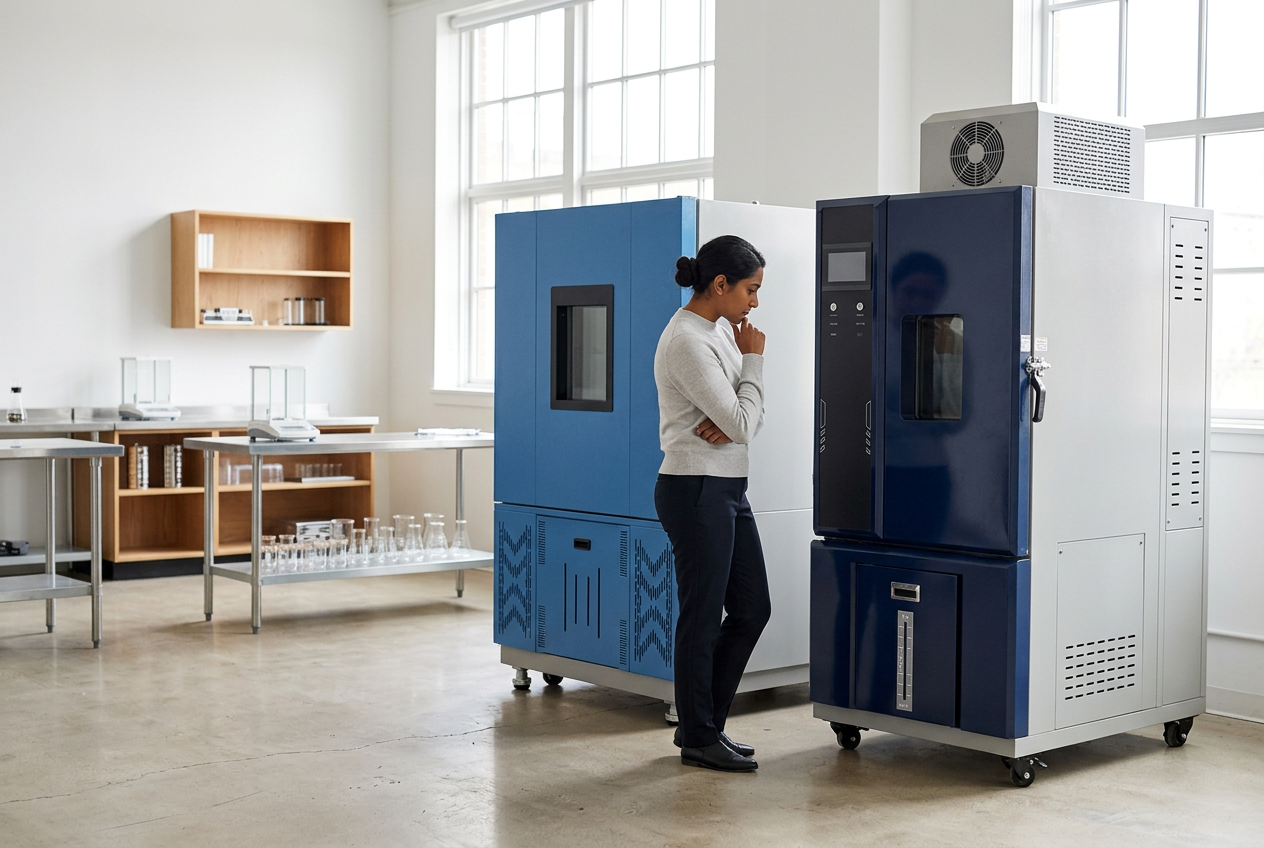
A temperature and humidity test chamber is an environmental test chamber that simulates defined temperature and relative-humidity conditions so that products, materials, and components can be evaluated for reliability, stability, durability, or performance. The right chamber is selected from the complete test profile: required temperature and RH, change rate, test duration, specimen size and load, airflow, utilities, data records, and applicable test method.
If you are sourcing a chamber in Malaysia, do not choose from the temperature range alone. Send the supplier your test profile and specimen information first. TestLabs can then advise whether a standard temperature and humidity chamber, a rapid-change configuration, a thermal shock chamber, or a custom solution is more appropriate.
1. Temperature range and stability
Start with the lowest and highest temperature required by the test method. Also record the dwell time at each set point, the permitted stability, the permitted spatial uniformity, and whether the specimen generates heat during the test.
A chamber’s headline temperature range is not the same as its guaranteed performance at every operating point. Pull-down time, heating rate, stability, uniformity, and achievable humidity can change with the set point, the test load, the room conditions, and the selected configuration. Ask the supplier to confirm the performance at the exact points that matter to your test.
If the test requires unusually low or high temperatures, provide the complete profile rather than only a single end point. The refrigeration system, insulation, heater capacity, airflow, and specimen heat load may all affect the final selection. Product-specific values should be checked against the current TestLabs temperature and humidity chamber page and confirmed with the technical team before they are quoted in a purchase specification.
2. Relative humidity range and control
State the required minimum and maximum relative humidity, the temperatures at which those RH values must be achieved, the duration of each condition, and whether the test is steady-state or cyclic. Relative humidity is linked to temperature, water-vapour pressure, and dew-point behaviour. A chamber that can reach a stated RH at one temperature may not reach the same RH at another temperature.
Ask about humidity stability, humidity uniformity, condensation control, water quality, humidification, water replenishment, and drainage. If low humidity is important, ask for the achievable RH at the required temperature rather than relying on a single headline RH range.
Do not describe a humidity range as universal. TestLabs’ product page displays product-specific temperature and RH values, but the final range and control performance must be confirmed for the selected model, options, test load, and test method.
3. Temperature change rate: cycling, rapid change, or thermal shock
Describe the test as a profile rather than simply asking for a “fast chamber.” There are important differences among the following applications:
Constant-temperature testing holds the specimen at a defined set point for a specified time.
Temperature cycling moves between two or more set points with defined dwell times and transition rates.
Rapid temperature change testing requires a higher controlled rate and may require special airflow, refrigeration, or heating capacity.
Thermal shock testing usually uses separate hot and cold zones, or a transfer mechanism, to expose a specimen to abrupt temperature transitions.
The air temperature shown by the controller is not automatically the same as the specimen temperature. Specimen mass, density, heat generation, fixture design, airflow, and sensor location can affect the actual response. Provide the required air profile and any required specimen-temperature profile to the supplier.
A standard temperature and humidity chamber should not be assumed to replace a thermal shock chamber. For a different equipment type, ask TestLabs to confirm the correct equipment category.
4. Internal working dimensions and test load
Select the internal working space from the complete test load, not only from the largest product dimension. Send the supplier the length, width, height, mass, quantity, fixture arrangement, shelf requirements, cable routing, and any operating or powered condition of the specimens.
The load must allow the chamber to circulate conditioned air around the specimens. Dense, heavy, or powered specimens may require more working space and greater heating or refrigeration capacity. A chamber that is technically large enough to contain the product may still be unsuitable if the load blocks airflow or changes the thermal response.
Ask the supplier to confirm the usable internal dimensions, shelf capacity, access opening, cable ports, door clearance, and the recommended loading arrangement. For large products or production-scale loads, compare a floor-standing or walk-in design with a benchtop unit. TestLabs also lists walk-in environmental chamber options in its equipment structure; the final design should be based on the test load and site access.
5. Cooling method, room conditions and utilities
Cooling method affects installation, room heat load, maintenance, and operating cost. An air-cooled condenser can simplify installation, but it releases heat into the test room. A water-cooled arrangement may be appropriate where room heat rejection or environmental conditions make it preferable, but it requires suitable water, drainage, piping, and installation planning.
Before requesting a quotation, confirm the available electrical supply, room temperature and humidity, ventilation or air-conditioning capacity, access route, floor loading, clearance around the chamber, water supply and drainage, and any exhaust or heat-rejection requirements. A supplier should review the site conditions before finalizing the configuration.
For Malaysian sites, identify the delivery location, such as Kuala Lumpur, Selangor, Penang, Johor, or another state, because access, installation, service response, and utility conditions can affect the project plan. Do not promise a delivery or installation timeline on the article unless the sales team has approved a current commitment.
6. Controls, data, safety and after-sales support
A chamber should support the way your laboratory works. Ask whether the controller can create the required program steps, record temperature and RH, export data, trigger alarms, and protect the equipment and specimen during a fault. Confirm sensor placement, data-logging interval, password or user controls, remote access, and integration requirements if the test requires traceable records.
Ask for the available calibration, verification, training, preventive-maintenance, warranty, and repair arrangements. The current TestLabs product page states that one-year manufacturer warranty, training, and after-sales support are available; confirm the exact scope, exclusions, service location, and documentation for the configuration being quoted.
Equipment capability is not the same as certification or compliance. If a customer or regulator specifies an IEC, ISO, automotive, pharmaceutical, medical-device, or other method, identify the exact edition, clauses, fixtures, conditioning, measurement uncertainty, and required records. Ask the supplier to explain how the proposed configuration supports the test. Do not present a chamber as “certified” merely because an equipment page lists a standard.
