
There is no universal chamber exposure time that equals a fixed number of outdoor years. Accelerated weathering testing can produce faster, controlled evidence of material degradation, but the result depends on the test method, material, failure mode, exposure cycle, climate and evaluation criteria.
For this reason, a laboratory should not promise that one day, one month or one week in a weathering chamber always represents a specific number of outdoor years. A better approach is to define the product application, the property to be measured, the applicable standard and the exposure end point before setting the test duration.
Why There Is No Fixed Days-to-Years Conversion
Outdoor weathering changes with geography, latitude, altitude, season, temperature, humidity, rainfall, pollution, shade, installation angle and the surrounding environment. Malaysia's tropical exposure is not identical to exposure in Singapore, Australia, Europe or North America.
A weathering chamber is more controlled. It uses defined settings for light source, irradiance, filter, temperature, humidity and moisture. Those settings improve repeatability, but they do not reproduce every outdoor condition. The relationship between accelerated exposure and real-world service life therefore has to be established for the specific material, product and application.
Accelerated weathering is especially useful for comparison testing. For example, a manufacturer can compare two coating formulations, plastics, inks, adhesives or exterior components under the same controlled cycle. The result can help identify relative durability and support product development. It should not be presented as an exact prediction that a specimen will last a certain number of outdoor years.
How Xenon-Arc Weathering Testing Works
A xenon-arc weathering chamber uses an optically filtered xenon-arc lamp to expose specimens to controlled light, heat and, depending on the method, moisture. Xenon-arc exposure is commonly selected when the test objective requires a broader simulation of sunlight, including ultraviolet, visible and infrared portions after filtration.
ASTM G155 covers the basic operation of xenon-arc lamp and water apparatus. The standard explains that the practice is used with a method that defines the exposure conditions and the way material-property changes will be evaluated. The selected filter, irradiance, temperature, humidity and water cycle can materially affect the result.
Xenon-arc weathering may be appropriate when the product is exposed to outdoor sunlight or sunlight through glass and the evaluation includes appearance, colour, gloss, strength or other physical properties. The final method must be chosen for the material and end-use application.
How Fluorescent UV Weathering Testing Works
A UV accelerated weathering test uses fluorescent ultraviolet lamps and controlled moisture and temperature cycles to evaluate the effects of the UV portion of sunlight. Depending on the chamber and method, moisture can be introduced through condensation, water spray or another defined cycle.
ASTM G154 covers fluorescent UV lamp and water apparatus for exposure of materials. It is intended to reproduce relevant weathering effects from sunlight and moisture, but the practice itself does not specify the exposure conditions that are best for every material. The lamp type, irradiance, black-panel or chamber temperature, condensation or spray cycle and exposure duration must therefore be reported and agreed for the application.
Fluorescent UV testing is often useful for coatings, plastics, polymers, sealants, adhesives, building materials, automotive components and other products where UV-related fading, chalking, cracking, gloss loss, embrittlement or strength change is important. UV testing is not automatically interchangeable with xenon-arc testing. It should be selected because its spectrum and moisture cycle are relevant to the failure mode being investigated.
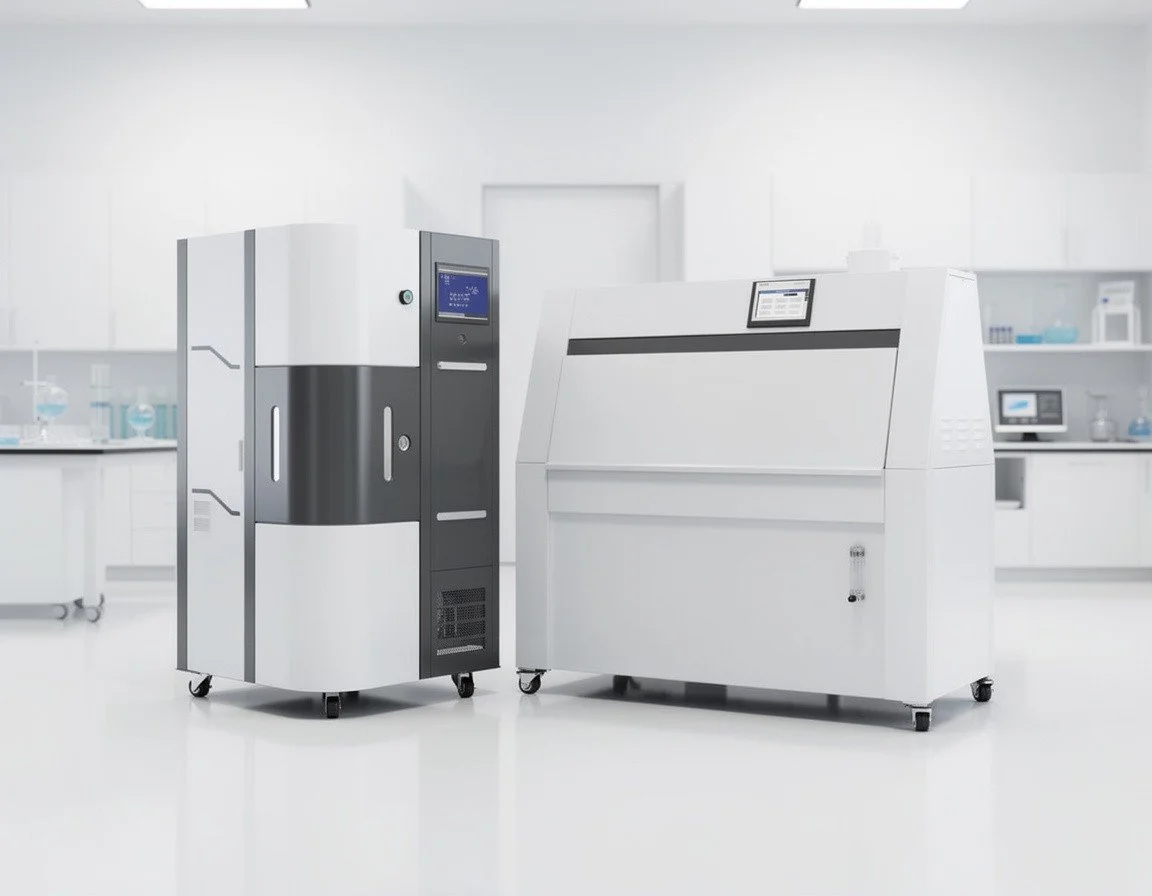
For equipment information, see TestLabs' Xenon Lamp Test Chamber and UV Lamp Weathering Test Chamber. If you are comparing methods, see Comparison of Xenon Arc Chamber and QUV Tester.
| Consideration | Xenon-arc weathering test | Fluorescent UV weathering test |
|---|---|---|
| Light source | Optically filtered xenon-arc lamp. | Fluorescent ultraviolet (UV) lamps. |
| Typical test objective | Evaluate changes under a broader controlled light exposure that may include UV, visible light and heat. | Evaluate the effects of the UV portion of sunlight together with defined temperature and moisture cycles. |
| Moisture simulation | May use humidity, water spray or another defined moisture cycle, depending on the method. | May use condensation, water spray or another defined moisture cycle, depending on the method. |
| Useful when | The product is exposed to sunlight or sunlight through glass and the broader light exposure is relevant to the failure mode. | UV-related degradation and outdoor moisture effects are the main concerns, such as fading, chalking, cracking or gloss loss. |
| Common decision inputs | Material, end-use environment, optical filter, irradiance, temperature, moisture cycle and evaluation property. | Material, lamp type, irradiance, temperature, condensation or spray cycle and evaluation property. |
| Important limitation | It does not provide a universal conversion from chamber time to outdoor years. | It does not provide a universal conversion from chamber time to outdoor years. |
Selection note: Choose the method and exposure cycle for the product, failure mode, applicable standard and intended use. Confirm the final conditions with the testing laboratory or equipment supplier.
Xenon Arc or UV Test: Which Method Should You Choose?
The answer depends on the product and the degradation mechanism that matters most. Xenon-arc testing is generally considered when a broader sunlight simulation is needed. Fluorescent UV testing is generally considered when the UV portion of sunlight and outdoor moisture cycles are the primary concern.
Neither method is universally “better.” A technically suitable test can be selected only after considering the material, product geometry, intended environment, target property, applicable customer or industry method, available sample quantity and required reporting.
The following practical questions help narrow the test method:
Is the product exposed outdoors, behind glass or mainly under indoor lighting?
Is the target change colour, gloss, cracking, chalking, peeling, embrittlement, tensile strength, adhesion or another property?
Does the application require a broad sunlight spectrum or a focused fluorescent UV exposure?
Is condensation, rain simulation or water spray part of the expected outdoor failure mechanism?
Does a customer specification or industry standard prescribe a lamp, filter, irradiance or cycle?
Will the result be used for product comparison, formulation development, quality control or a service-life model?
A weathering laboratory should document the selected lamp, filter or UV source, irradiance, temperature, humidity, moisture cycle, specimen preparation, exposure duration and evaluation method. ASTM G154 and ASTM G155 both caution that exposure conditions can produce different results and that the operating conditions should accompany the reported result.
What Determines the Required Test Duration?
The test duration should be tied to a measurable end point rather than to an unsupported outdoor-years formula. Examples include a defined colour difference, gloss retention, change in tensile strength, visible cracking, adhesion loss, chalking level or another product-specific criterion.
Before a test begins, define the specimen, the control or comparison sample, the property to measure, the exposure cycle and the inspection intervals. If the goal is to compare two materials, test them in the same apparatus and cycle. If the goal is to support a service-life claim, additional outdoor correlation work may be required.
| Planning item | What to define before testing |
|---|---|
| Product and material | Product type, material, formulation or coating system, intended use and any construction details that may affect exposure. |
| Exposure environment | Outdoor, indoor or behind-glass exposure; installation angle; shade; and the climate or market relevant to the product. |
| Test method or standard | Customer specification, industry method or laboratory practice, such as an applicable xenon-arc or fluorescent UV procedure. |
| Light source and settings | Xenon-arc filter or fluorescent UV lamp type, irradiance, temperature and other controlled exposure settings required by the method. |
| Moisture cycle | Condensation, water spray, humidity or another defined cycle, including the sequence and duration required by the method. |
| Property to measure | Colour, gloss, cracking, chalking, adhesion, tensile strength, impact performance or another measurable product property. |
| End point and inspection intervals | Failure criterion, acceptance threshold and the intervals at which specimens will be inspected or measured. |
| Controls and reporting | Reference materials, specimen quantity, conditioning, photographs, measurements and the exposure conditions to include in the report. |
Important: Exposure duration must be confirmed for the specific material, method and evaluation criterion. This table is a planning checklist, not a days-to-years conversion.
How to Request an Accelerated Weathering Test or Chamber Quote
To help TestLabs recommend a suitable accelerated weathering test or chamber, send the following information to sales@testlabs.my:
Product type, material and intended application.
Specimen dimensions, quantity and approximate weight.
Outdoor, indoor or behind-glass exposure conditions.
The property or failure mode to be evaluated.
Preferred method or standard, if already specified by a customer.
Required lamp type, filter, irradiance or moisture cycle, if known.
Target exposure duration or inspection schedule, if known.
Delivery location, such as Kuala Lumpur, Penang, Selangor, Johor or another location in Malaysia.
Whether you need laboratory testing, a weathering chamber, or both.
For equipment selection, visit the Xenon Arc Aging Test Chamber page or the UV Test Chamber page.
Frequently Asked Questions About Accelerated Weathering Testing
Is one day in a weathering chamber equal to one month or one year outdoors?
No. There is no universal conversion because outdoor climate and chamber exposure conditions are different. A test duration must be selected for the material, failure mode, exposure method, standard and evaluation criteria.
What is the difference between a xenon-arc test and a UV test?
A xenon-arc test uses an optically filtered xenon-arc lamp to provide a broader controlled light exposure. A fluorescent UV test focuses on the UV portion of sunlight and usually combines UV exposure with controlled condensation or water-spray cycles. The suitable method depends on the product and the degradation mechanism under investigation.
Which standard is used for fluorescent UV weathering testing?
ASTM G154 is a commonly referenced practice for operating fluorescent ultraviolet lamp and water apparatus. The correct lamp, irradiance, temperature, moisture cycle and evaluation method still need to be defined for the product.
Which standard is used for xenon-arc weathering testing?
ASTM G155 is a commonly referenced practice for operating xenon-arc lamp and water apparatus. It does not create a universal outdoor-years conversion, and the detailed exposure conditions must be reported with the result.
What information should I provide when requesting a weathering-test quotation?
Provide the product and material, intended environment, specimen size and quantity, target property or failure mode, required standard or customer specification, preferred xenon-arc or fluorescent UV method, moisture cycle, exposure duration and delivery location. This information allows the laboratory or equipment supplier to scope the request more accurately. Email sales@testlabs.my or call/WhatsApp +6018-2030306.
