
Xenon Arc vs QUV Weathering Test: Which Should You Choose?
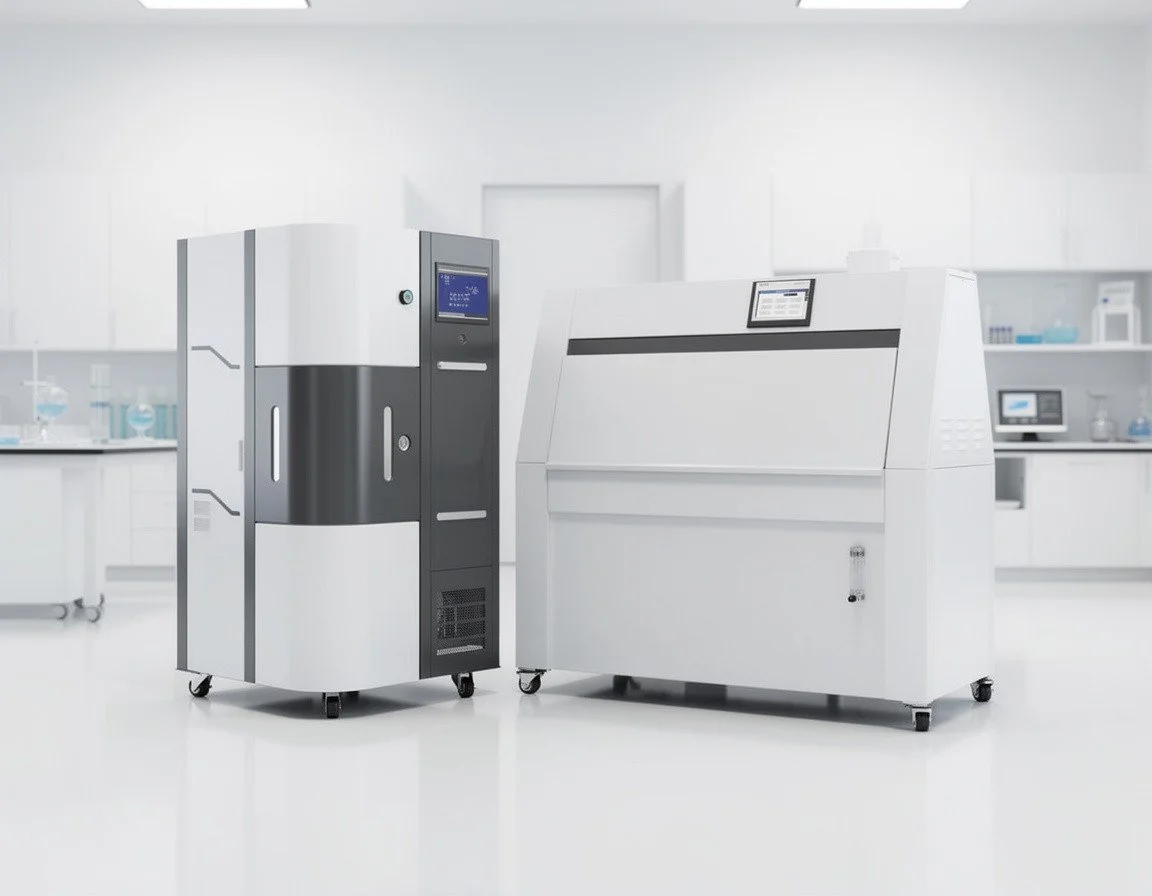
Xenon Arc vs Fluorescent UV Weathering Test Chamber
A xenon-arc weathering test and a fluorescent UV weathering test are not interchangeable. The suitable method depends on the product, the outdoor or indoor environment, the failure mode being investigated, the applicable customer or industry method, and the property that will be measured.
In general, xenon arc is considered when a broader controlled light exposure is relevant to the product. Fluorescent UV testing, including QUV-style testing, is considered when the UV portion of sunlight and defined moisture cycles are the main concerns. Neither method is universally better, and neither creates a guaranteed conversion between chamber exposure time and outdoor service life.
Quick Answer: Xenon Arc or Fluorescent UV?
Choose the method that best represents the degradation mechanism you need to evaluate.
Consider xenon arc when the product is exposed to sunlight or sunlight through glass and the evaluation may be affected by a broader controlled light exposure, including ultraviolet, visible light and heat after optical filtering.
Consider fluorescent UV or QUV-style testing when UV-related degradation and controlled condensation or water-spray cycles are central to the test objective.
Consider a method specified by the customer or industry standard when the product must be evaluated against a defined procedure.
Consider comparative testing when the objective is to rank materials, coatings or formulations under the same controlled cycle.
The final choice should be confirmed against the material, intended use, specimen geometry, target property and reporting requirements.
What Is a Xenon-Arc Weathering Test?
A xenon-arc weathering chamber exposes test specimens to light from an optically filtered xenon-arc lamp under controlled environmental conditions. Depending on the selected method and equipment configuration, the exposure can include controlled light, temperature, humidity and moisture such as water spray.
ASTM G155 describes basic practices for operating xenon-arc lamp and water apparatus. It is intended to be used with a method that defines the exposure conditions and how changes in material properties will be evaluated. The standard does not provide a universal test duration or a fixed conversion from chamber time to outdoor years.
Xenon-arc testing may be relevant for products such as coatings, plastics, inks, textiles, automotive components, building materials and other products exposed to sunlight. The appropriate filter and exposure cycle depend on the material and end-use environment. A test laboratory should report the lamp, filter, irradiance, temperature, humidity, moisture cycle, specimen preparation, exposure time and evaluation method.
Xenon arc can be useful when the test needs to consider appearance, colour, gloss, strength or another property affected by the selected light and moisture exposure. It is not automatically the correct method for every material.
What Is a Fluorescent UV or QUV Weathering Test?
A fluorescent UV weathering test uses ultraviolet lamps and controlled temperature and moisture cycles to evaluate material changes associated with UV exposure. A QUV tester is a branded type of fluorescent UV accelerated weathering tester; “fluorescent UV” is the generic method description.
Fluorescent UV equipment commonly alternates UV exposure with condensation or another defined moisture cycle. Some configurations also provide water spray. These cycles can be used to evaluate changes such as fading, gloss loss, chalking, cracking, crazing, embrittlement, adhesion loss or strength change, depending on the material and the evaluation method.
ASTM G154 describes basic procedures for operating fluorescent UV lamp and water apparatus. It states that the practice covers a range of exposure conditions and should be accompanied by the specific operating conditions used for the result. ASTM G154 also does not specify the best exposure condition for every material.
Different fluorescent UV lamp types are selected for different applications. The lamp, irradiance, temperature, condensation or spray cycle and specimen arrangement must be selected for the product and the method. A more severe lamp or cycle may accelerate degradation, but it may not represent the intended service environment.
For equipment information, visit TestLabs' UV Lamp Weathering Test Chamber. Confirm the exact model, lamp, control system and configuration with TestLabs before quotation.
Xenon Arc Versus Fluorescent UV: Key Differences
| Decision factor | Xenon-arc weathering test | Fluorescent UV or QUV-style test |
|---|---|---|
| Light source | Optically filtered xenon-arc lamp. | Fluorescent ultraviolet lamps selected for the application. |
| Exposure objective | Broader controlled light exposure that may include ultraviolet, visible light and heat after filtration. | Controlled exposure focused on the UV portion of sunlight, commonly combined with temperature and moisture cycles. |
| Moisture options | May include humidity, condensation or water spray, depending on the equipment and method. | Commonly uses condensation; some configurations also provide direct water spray. |
| May be appropriate when | Sunlight or sunlight through glass and a broader controlled light exposure are relevant to the product's failure mode. | UV-related degradation and defined outdoor moisture effects are the main concerns. |
| Typical properties evaluated | Colour, gloss, appearance, strength or other properties affected by the selected light, heat and moisture exposure. | Fading, gloss loss, chalking, cracking, crazing, embrittlement, adhesion or strength change, depending on the method. |
| Important settings | Optical filter, irradiance, temperature, humidity, moisture cycle, specimen mounting and evaluation method. | Lamp type, irradiance or control approach, temperature, condensation or spray cycle, specimen mounting and evaluation method. |
| Standards commonly referenced | ASTM G155 is a commonly referenced practice for xenon-arc lamp apparatus. The applicable product method must also be confirmed. | ASTM G154 is a commonly referenced practice for fluorescent UV lamp apparatus. The applicable product method must also be confirmed. |
| Key limitation | It does not provide a universal conversion from chamber time to outdoor years. | It does not provide a universal conversion from chamber time to outdoor years. |
Selection note: Choose the method for the product, failure mode, intended environment, applicable specification and evaluation property. Confirm the final test conditions with the testing laboratory or equipment supplier.
Which Test Is Suitable for Coatings, Plastics and Outdoor Products?
For coatings and painted surfaces, consider whether the main concern is colour and appearance change, UV-related chalking or cracking, adhesion loss, moisture exposure, or a combination of these effects. The required method may differ between an exterior coating, an interior coating near a window and a coating exposed to rain and direct sunlight.
For plastics and polymer products, consider whether the product is used outdoors, behind glass or in an environment where UV, visible light, heat and moisture contribute to degradation. The specimen shape and mounting method can also affect the exposure result.
For automotive and building products, follow the customer's or industry's required method where one exists. Test conditions can vary significantly between standards, so the report should identify the exact exposure cycle and evaluation criteria.
For research and development or quality control, comparative testing is often useful. Test specimens and control materials should be exposed under the same apparatus and cycle. A result from one model or configuration should not be compared with a result from a different apparatus unless suitable reproducibility or correlation has been established.
For equipment selection, see the Xenon Arc Test Chamber and UV Test Chamber pages.
How Standards and Exposure Settings Affect the Result
ASTM G154 and ASTM G155 are exposure practices. They describe basic operating principles and procedures, but they do not by themselves establish that a product is certified or guarantee a service-life result.
The following conditions can affect the result:
Light source and lamp type.
Xenon optical filter or fluorescent UV lamp selection.
Irradiance and calibration approach.
Black-panel or chamber temperature.
Relative humidity and condensation conditions.
Water-spray duration and water quality, where spray is required.
Specimen preparation, orientation, mounting and quantity.
Control or reference material.
Inspection interval and property measurement method.
Total exposure duration and defined failure or acceptance criterion.
ASTM G154 and ASTM G155 both indicate that different operating conditions can produce different results. The test report should therefore identify the actual conditions used rather than reporting only “xenon test” or “QUV test.”
A test also should not be described as “one day equals one year outdoors” unless a product-specific correlation study supports that statement. Outdoor climate varies by geography, season, installation and environment.
Frequently Asked Questions About Xenon Arc and QUV Testing
What is the main difference between a xenon-arc test and a fluorescent UV test?
A xenon-arc test uses an optically filtered xenon-arc lamp for a broader controlled light exposure. A fluorescent UV test uses ultraviolet lamps to focus on the UV portion of exposure and commonly combines UV with condensation or water-spray cycles. The suitable method depends on the product, failure mode and applicable method.
Is QUV the same as a fluorescent UV weathering test?
QUV is a product name associated with Q-Lab fluorescent UV accelerated weathering testers. Fluorescent UV weathering test is the generic method description. Other manufacturers may offer equipment with different models, lamp options, controls and configurations, so the exact equipment should be confirmed before quotation.
Which test is better for coatings and plastics?
Neither method is universally better. Xenon arc may be appropriate when a broader controlled light exposure is relevant, while fluorescent UV may be appropriate when UV-related degradation and defined moisture cycles are the main concerns. The product, intended environment, target property, specimen and applicable standard should determine the choice.
What are ASTM G154 and ASTM G155?
ASTM G154 is a commonly referenced practice for operating fluorescent ultraviolet lamp and water apparatus. ASTM G155 is a commonly referenced practice for operating xenon-arc lamp and water apparatus. These are exposure practices, not product certifications by themselves, and the detailed exposure conditions and evaluation method must be reported.
Can xenon-arc or QUV test time be converted directly into outdoor years?
No. There is no universal conversion because outdoor climate, installation, material, lamp, filter, irradiance, temperature, moisture cycle and evaluation criteria vary. A product-specific correlation study may be needed to support a service-life model.
What information should I provide for a xenon or fluorescent UV quotation?
Provide the product and material, intended environment, specimen dimensions and quantity, target property or failure mode, required customer or industry method, preferred xenon-arc or fluorescent UV approach, moisture cycle, exposure duration or inspection schedule, and delivery location. Email sales@testlabs.my or call/WhatsApp +6018-2030306.
