

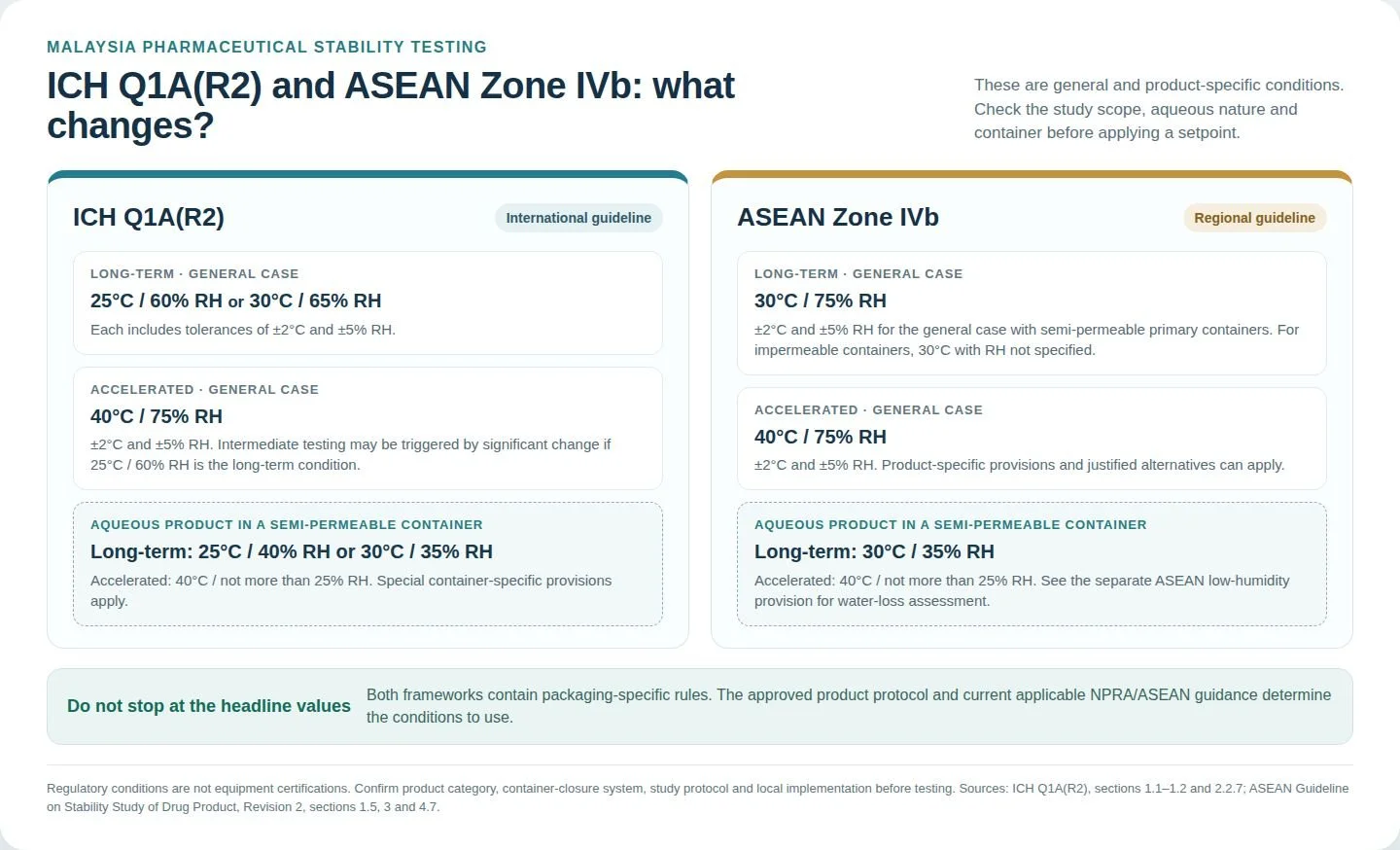
Short answer: ICH Q1A(R2) and the ASEAN stability guideline do not set one interchangeable long-term condition. ICH Q1A(R2) gives general-case long-term options of 25°C/60% RH or 30°C/65% RH. ASEAN identifies Zone IVb long-term conditions around 30°C/75% RH, with important exceptions for product type and packaging. For Malaysia, the applicable NPRA route, product category, container-closure system and approved study protocol matter more than choosing whichever guideline appears familiar.
The distinction is especially important for aqueous products in semi-permeable packaging. Both frameworks have separate low-humidity conditions for this case, so 30°C/75% RH should not be presented as a universal condition for every stability study.
ICH Q1A(R2) vs ASEAN Zone IVb at a glance
The table below compares selected general-case conditions and shows the main packaging exception. It is a guide to reading the documents, not a substitute for the approved protocol or current product-specific NPRA requirements. 1 3
| Comparison point | ICH Q1A(R2) | ASEAN Zone IVb |
|---|---|---|
| Scope | Core stability data guidance for new drug substances and products, primarily for the EC, Japan and United States regions. ICH Q1A(R2) says it does not necessarily cover registration in other regions.1 | ASEAN guidance for drug-product registration and variations. It covers new chemical entities, generics and variations, with stated exclusions including biologicals and products containing vitamins or minerals.2 |
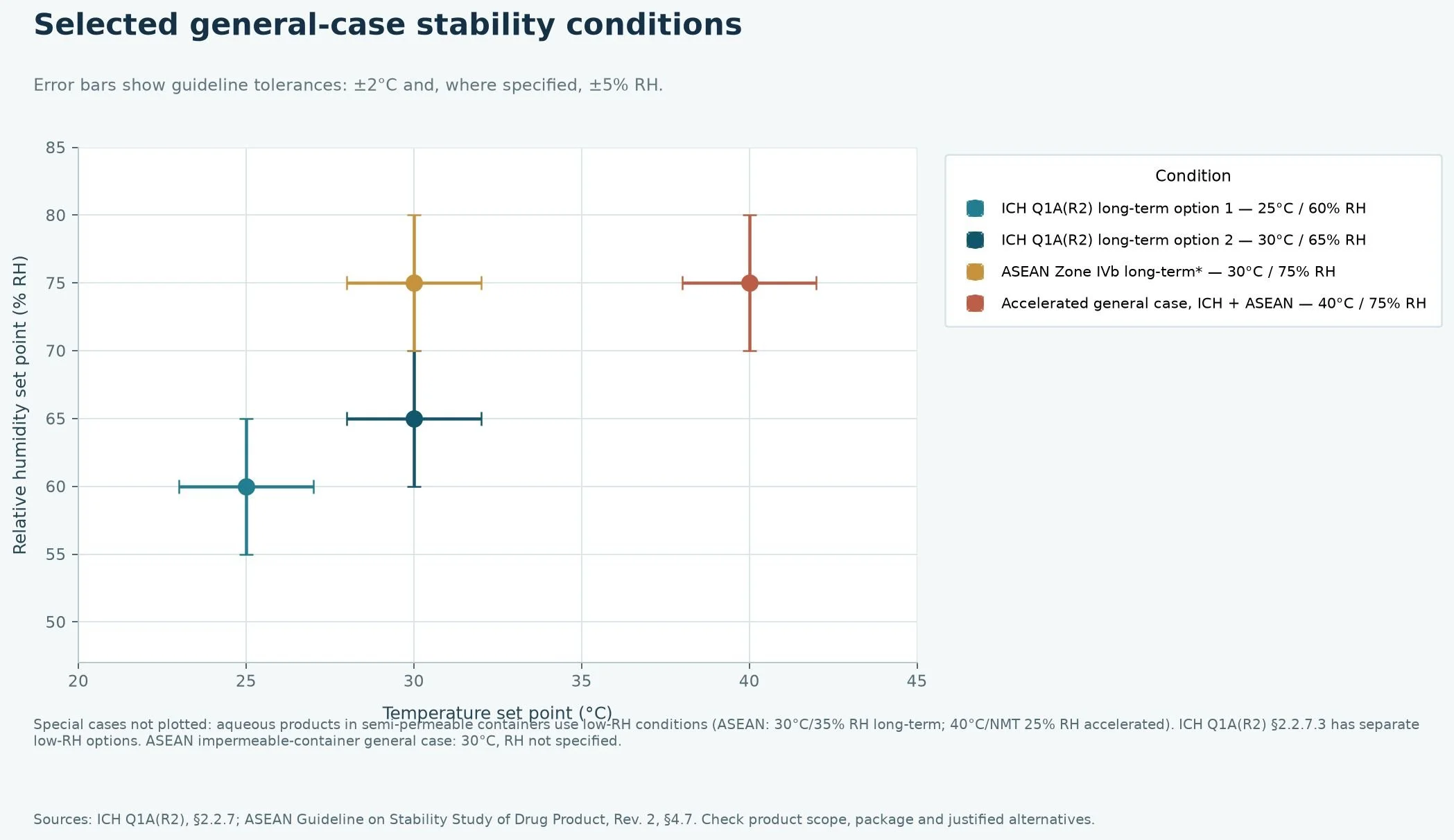
| General-case long-term | 25°C ± 2°C / 60% RH ± 5% RH or 30°C ± 2°C / 65% RH ± 5% RH. | 30°C ± 2°C / 75% RH ± 5% RH in the general case for semi-permeable primary containers. For impermeable containers, the ASEAN general case lists 30°C ± 2°C with RH not specified.2 |
| Aqueous product in a semi-permeable container | Special low-humidity case: long-term 25°C ± 2°C / 40% RH ± 5% RH or 30°C ± 2°C / 35% RH ± 5% RH; accelerated 40°C ± 2°C / NMT 25% RH.1 | Special low-humidity case: long-term 30°C ± 2°C / 35% RH ± 5% RH; accelerated 40°C ± 2°C / NMT 25% RH.2 |
| Accelerated, general case | 40°C ± 2°C / 75% RH ± 5% RH. | 40°C ± 2°C / 75% RH ± 5% RH. Product- and package-specific provisions may change the applicable condition.2 |
| Intermediate condition | 30°C ± 2°C / 65% RH ± 5% RH may be needed if 25°C/60% RH is selected for long-term testing and significant change occurs at accelerated conditions. If 30°C/65% RH is the long-term condition, there is no separate intermediate condition.1 | The general Zone IVb case is not a direct substitute for the ICH intermediate condition. Apply the ASEAN storage provision and study design relevant to the product and package.2 |
| Malaysia NPRA example | ICH Q1A(R2) is a comparator; it does not by itself establish the Malaysian submission requirement. | NPRA’s pre-submission page under Generic (Scheduled Poison) lists a minimum of 12 months real-time data at 30°C/75% RH and 6 months accelerated data at 40°C/75% RH. It lists 3 batches for imported/exported products and 1 for locally manufactured products. This is category-specific, not a universal rule.3 |
Notes: NMT means “not more than.” Stability conditions are not equipment certifications. Confirm the product category, container-closure system, applicable NPRA instructions and approved study protocol before testing. The NPRA page reviewed links to a 2013 ASEAN Revision 1 document; verify which revision and local requirements currently apply.
Sources: ICH Q1A(R2) · ASEAN Stability Guideline, Revision 2 · NPRA pre-submission page.
Why the long-term values differ
ICH Q1A(R2) is a harmonised guideline developed for a core stability data package for new drug substances and products in its stated ICH-region scope. It describes the general long-term choices as 25°C/60% RH or 30°C/65% RH. The latter can serve as an alternative long-term condition; when it is selected, the guideline does not require a separate intermediate condition at the same 30°C/65% RH setpoint.
ASEAN's regional drug-product guideline identifies Zone IVb conditions for long-term stability testing. In its general case, the headline value is 30°C/75% RH. This higher relative humidity is not just a different way of writing 30°C/65% RH: the values describe different humidity conditions, and the study protocol needs to match the relevant regional and product requirements.
That does not mean every product registered in Malaysia should automatically be placed at 30°C/75% RH. The ASEAN guideline separates the general case from special storage and packaging cases. For example, it discusses impermeable containers, aqueous products in semi-permeable containers, refrigerated products, frozen products and other justified conditions.
The packaging exception many summaries leave out
A semi-permeable container can allow water vapour to pass through. For an aqueous product, the study may need to examine water loss as well as the product's other stability attributes. Both ICH Q1A(R2) and the ASEAN guideline therefore provide low-relative-humidity conditions for this case. 1
Under ICH Q1A(R2), the long-term low-humidity options are 25°C/40% RH or 30°C/35% RH. The accelerated condition is 40°C at not more than 25% RH. If the 30°C/35% RH option is selected for long-term testing, there is no intermediate condition. When 25°C/40% RH is selected, intermediate testing at 30°C/65% RH may be required if significant change other than water loss occurs under accelerated conditions. 1
ASEAN's specific aqueous semi-permeable-container section lists 30°C/35% RH for long-term and 40°C at not more than 25% RH for accelerated testing. It also describes evaluating water loss and permits scientifically justified approaches for deriving water-loss data under specified conditions. 2
The practical lesson is simple: do not select a humidity setpoint from a one-line “Zone IVb” summary alone. Identify whether the product is aqueous, whether the proposed container is impermeable or semi-permeable, and which study section applies. The quality or regulatory team should confirm the protocol before samples are placed in a chamber.
What NPRA's published page says for one application category
The NPRA pre-submission checklist has a section specifically labelled “Product Category: Generic (Scheduled Poison).” Its stability subsection says to provide a minimum of 12 months of real-time data at 30°C/75% RH and six months of accelerated data at 40°C/75% RH. It lists different minimum batch counts by origin: three batches for imported/exported products and one batch for locally manufactured products. 3
That is useful Malaysia-specific context, but it is not a universal template for every drug. The page is located within the stated generic scheduled-poison category. The ASEAN guideline itself excludes biologicals and drug products containing vitamins or minerals, and it treats certain packaging and storage cases separately. Applicants should confirm the current NPRA requirements for the exact product classification, submission route, formulation, container and proposed shelf-life. 2
There is also a version-control point worth checking. The ASEAN regional guideline Revision 2 is dated 2018, while the NPRA pre-submission page reviewed links to the 2013 Revision 1 guideline and its related Q&A. Before relying on a copied checklist, confirm which ASEAN revision and NPRA instructions currently apply to the application. 2
As of this article review, the EMA page for the consolidated ICH Q1 guideline lists it as a Step 2b draft with consultation closed. The draft is intended to consolidate the earlier ICH stability guideline series, but it should not be treated as an adopted requirement merely because it is available. Check the regulator's current status and local implementation before updating a protocol or submission. 4
A practical decision path for a Malaysian stability programme
Start with the registration route, not with the chamber catalogue. Identify the product category, whether the submission is for a new chemical entity, a generic, a variation or another product type, and which regulator's requirements apply. If the product falls outside the ASEAN guideline's stated scope, do not assume the general Zone IVb table answers the question. 2
Next, define the product and package. Record whether the formulation is aqueous, the proposed container-closure materials, the pack size and fill, and whether the packaging is considered impermeable or semi-permeable. This step can change the required humidity condition. For aqueous semi-permeable products, review the low-humidity requirements instead of defaulting to 30°C/75% RH. 1
Then write the protocol conditions explicitly. State the long-term and accelerated setpoints, tolerances, duration, sampling intervals, test attributes, acceptance criteria, batch plan, proposed shelf-life and any justified alternative. Distinguish long-term, intermediate, accelerated and stress testing. These terms describe different roles in a stability programme; accelerated testing does not automatically replace real-time long-term data. 1 3
Finally, translate the protocol into an equipment and qualification specification. Ask whether the proposed chamber can maintain the required setpoints and tolerances under the intended operating and loaded conditions. Review usable capacity, shelf layout, airflow, recovery after door opening, alarms, power-failure response, calibration, mapping, data recording and access requirements. Define installation, operational and performance qualification responsibilities before ordering.

Common mistakes to avoid
Treating 30°C/65% RH and 30°C/75% RH as equivalent. Both use 30°C, but they represent different humidity setpoints. Follow the applicable guidance and protocol rather than substituting one for the other.
Treating 40°C/75% RH as the long-term condition. It is the general accelerated condition in both guidelines. Accelerated data may help assess certain changes and excursions, but it does not erase the need for the applicable long-term study. 1
Applying the general case to every container. Impermeable packaging and aqueous products in semi-permeable packaging have specific humidity considerations. Confirm the container-closure system before finalizing the condition. 1
Assuming that an “ICH-compliant chamber” claim proves a study is compliant. ICH Q1A(R2) defines stability-study expectations, not a blanket equipment certification. Review the chamber's documented performance, calibration, mapping, monitoring and records against the actual protocol.
Copying an old submission checklist without checking its scope or revision. NPRA pages, ASEAN revisions and product requirements can differ. Confirm the latest instructions for the product category and local submission route before the study begins. 2 4
Frequently asked questions
Does ICH Q1A(R2) require 30°C/75% RH?
No. In its general product case, ICH Q1A(R2) lists 25°C/60% RH or 30°C/65% RH for long-term testing and 40°C/75% RH for accelerated testing. It has separate provisions for certain products and packaging, including aqueous products in semi-permeable containers. 1
Is 30°C/75% RH the condition for every drug product in Malaysia?
No single blog summary can establish the condition for every product. The ASEAN guideline gives Zone IVb conditions for its scope, while NPRA requirements depend on the product category, submission route and applicable study design. Packaging can also change the humidity condition. Use current product-specific NPRA instructions and the approved protocol. 2
Is 30°C/65% RH the same as ASEAN Zone IVb?
No. The temperature is the same, but the relative humidity is different. ICH Q1A(R2) includes 30°C/65% RH as a general-case long-term option. ASEAN identifies Zone IVb long-term conditions around 30°C/75% RH, subject to the guideline's product and packaging provisions. 1
Does accelerated testing replace long-term testing?
No. Accelerated and long-term studies have different purposes and conditions. The NPRA checklist page for Generic (Scheduled Poison) lists both real-time and accelerated data. Confirm the required periods and batches for the specific application rather than treating accelerated data as a substitute. 1 3
What should I specify when requesting a stability chamber quotation?
Share the required setpoints and tolerances, the product and container type, sample quantity and dimensions, planned study duration and sampling, loading pattern, monitoring and alarm requirements, site utilities, and any mapping or qualification documentation needed. Ask the supplier to confirm performance for the proposed configuration rather than relying on a catalogue range alone.
Is the consolidated ICH Q1 guideline already in force?
The EMA page reviewed for this article lists the consolidated ICH Q1 as a Step 2b draft with consultation closed. Check the current ICH and NPRA status before treating any draft text as a requirement. 4
Planning a stability chamber project in Malaysia?
TestLabs can discuss chamber format, sample capacity, monitoring, documentation and support requirements for pharmaceutical stability work. If you are comparing a cabinet chamber with a walk-in stability room, share the study conditions, packaging type, approximate sample load and site location so the proposed configuration can be reviewed against your needs.
Request an enquiry through the drug stability test chamber page or the stability room page, or email sales@testlabs.my. TestLabs lists support across Penang, Selangor, Johor and Kuala Lumpur. Please confirm model-specific performance, included qualification and documentation scope in the quotation.
Regulatory note: This article is an educational summary, not regulatory or legal advice. Product classification, package design, protocol, country implementation and NPRA requirements may change the applicable conditions. Verify primary guidance before starting a study or preparing a registration dossier.
