
Do Salt Spray Test Hours Predict Real-World Corrosion Life?
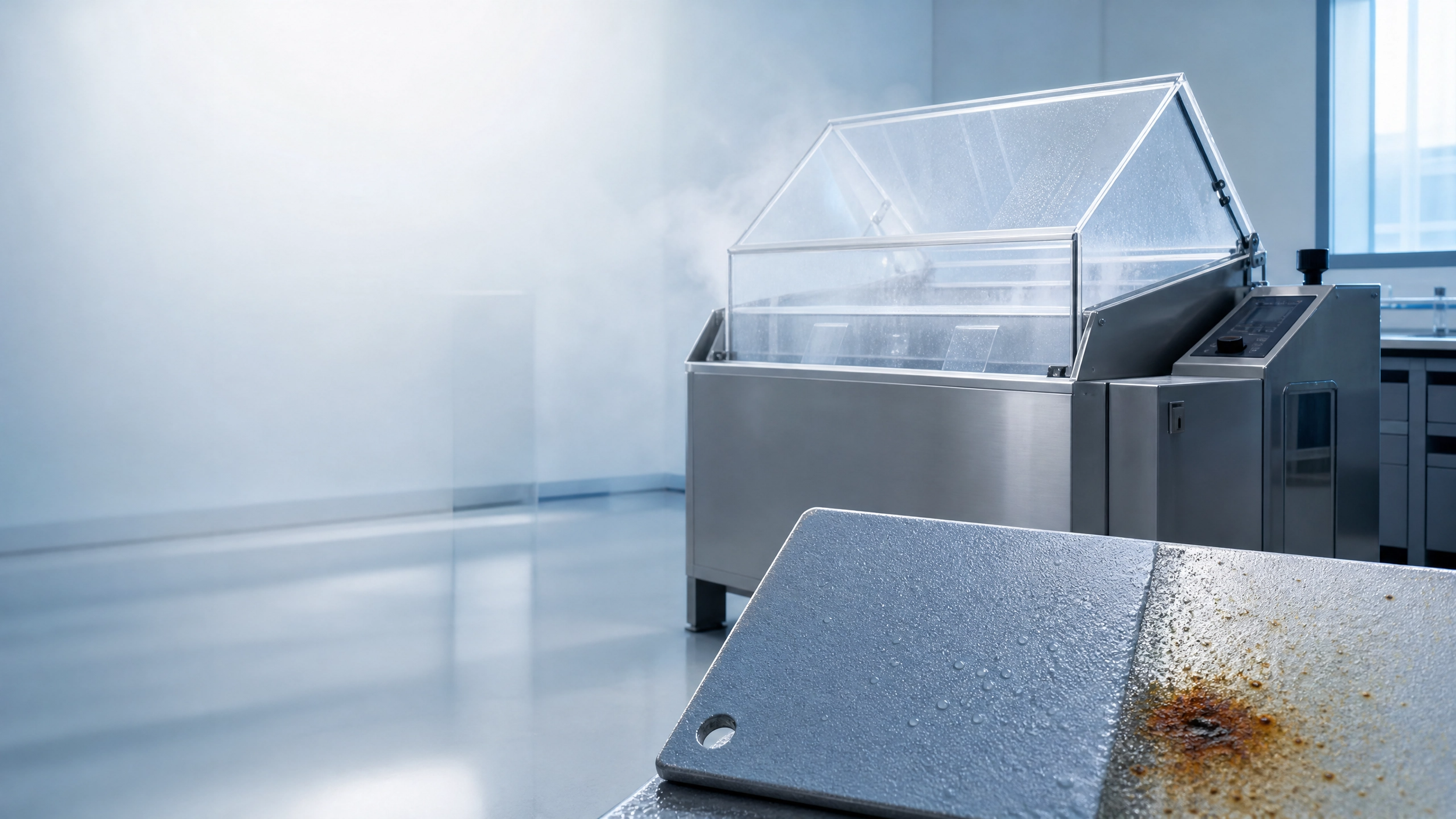
Short answer: No. There is no reliable universal formula that converts salt spray test hours into a fixed number of years of outdoor service. ASTM B117 and ISO 9227 salt spray tests create controlled artificial corrosion conditions. They are useful for checking coating quality, identifying defects, and comparing specimens tested under the same conditions, but the result should not be used alone to predict long-term corrosion life.
For example, 1,000 hours of salt spray exposure is approximately 41.7 days inside a test chamber. It does not automatically equal 10 years of outdoor performance. Any service-life relationship must be supported by product-specific evidence, relevant environmental exposure, and an appropriate test programme.
What is a salt spray test?
A salt spray test, also called a salt fog test, exposes metal or coated specimens to a controlled corrosive atmosphere inside a test chamber. The chamber produces a fine salt mist for a defined period. After exposure, the specimens are assessed against agreed failure criteria, such as red rust, blistering, coating breakdown, or corrosion creep from a scribed area.
ASTM B117 is a standard practice for operating salt spray fog apparatus. It specifies the apparatus, procedure, and conditions used to create and maintain the salt spray environment. It does not prescribe the specimen type, exposure period, or interpretation for every product.
ISO 9227:2022 specifies the apparatus, reagents, and procedures for neutral salt spray (NSS ), acetic acid salt spray (AASS), and copper-accelerated acetic acid salt spray (CASS). ISO states that these tests are particularly useful for detecting discontinuities such as pores and other defects in certain metallic, organic, anodic oxide, and conversion coatings. ISO 9227 also states that salt spray methods are not intended to rank different materials or predict long-term corrosion resistance by themselves.
Laboratory comparison is not the same as field prediction
Does 1,000 hours of salt spray equal 10 years outdoors?
No. A statement such as “1,000 hours of salt spray equals 10 years of outdoor durability” should not be treated as a general engineering rule.
Salt spray duration is the length of time that a specimen remains in a defined laboratory environment. Outdoor service life is influenced by a much wider combination of conditions. These conditions can change from one installation and climate to another.
A coating exposed near a marine environment in Malaysia may experience different corrosion stresses from a coating used indoors, under a roof, or in a dry industrial area. The same nominal coating can also perform differently when the substrate, surface preparation, coating thickness, edges, fasteners, joints, or maintenance programme changes.
Why salt spray hours cannot be converted directly into years
1. The chamber does not reproduce every outdoor condition
A conventional salt spray test provides a continuous, controlled salt fog. Outdoor products experience changing wet and dry periods, rain, condensation, temperature variation, humidity, ultraviolet radiation, pollutants, abrasion, and mechanical damage. These factors can interact in ways that are not reproduced by a continuous salt fog test.
2. Coating systems respond differently
Two coatings can produce different salt spray results but perform differently in a particular service environment. Performance depends on the substrate, pretreatment, primer, intermediate coat, topcoat, coating thickness, curing, surface cleanliness, edges, joints, and application quality.
3. The test method and failure criterion matter
Neutral salt spray, acetic acid salt spray, and copper-accelerated acetic acid salt spray are not interchangeable. A reported number of hours must be read together with the test method, solution, chamber conditions, specimen preparation, exposure period, and acceptance criterion.
A result based on first red rust is not directly equivalent to a result based on blistering, coating delamination, mass loss, or corrosion creep from a scribe.
4. Laboratory comparison is not the same as field prediction
ASTM B117 states that prediction of performance in natural environments has seldom correlated with salt spray results when salt spray is used as standalone data. It further cautions that correlation and extrapolation are not always predictable.
The practical meaning is that salt spray results are most useful when the specimens are prepared, exposed, and evaluated under comparable conditions. The result should be interpreted against the relevant product specification and intended service environment.
What can a salt spray test tell you?
Salt spray testing can provide useful evidence when the test method and evaluation criteria are suitable for the product. It can help a manufacturer or quality team to:
•Identify coating discontinuities, pores, weak edges, and damage.
•Check whether a coating or treatment process remains consistent between production batches.
•Compare specimens that use the same substrate, preparation, coating system, and evaluation criteria.
•Investigate whether a product meets a specified salt spray exposure requirement.
•Support product development and quality-control decisions.
Salt spray testing does not, by itself, establish a guaranteed number of years before corrosion will occur outdoors.
What salt spray test results cannot prove
A salt spray report should not be used alone to claim that:
•A particular number of test hours equals a fixed number of outdoor years.
•One coating will always outperform another in every climate and service environment.
•A coating will remain free from corrosion throughout its entire product life.
•A test result from one specimen or chamber can be compared directly with a result from a different test setup.
•Passing a salt spray requirement proves compliance with every other corrosion, durability, or regulatory requirement.
The correct interpretation depends on the applicable product specification, customer requirement, test method, specimen preparation, and acceptance criteria.
What Salt Spray Test Results Can and Cannot Tell You
| Aspect | What the result can support | What the result cannot establish by itself |
|---|---|---|
| Exposure duration | How long the specimen remained in the defined salt spray environment. | A fixed number of outdoor service years. For example, 1,000 hours is approximately 41.7 chamber days, not an automatic 10-year field-life claim. |
| Coating condition | Evidence of corrosion, blistering, coating breakdown, or corrosion creep against an agreed evaluation criterion. | That the coating will remain defect-free throughout its complete product life in every environment. |
| Controlled comparison | A comparison of specimens prepared, exposed, and evaluated under the same defined conditions. | That one coating will always outperform another when substrates, preparation, chambers, environments, or evaluation criteria differ. |
| Quality control | Evidence that a production or surface-treatment process is consistent with a specified requirement. | Automatic compliance with every corrosion, durability, regulatory, or product-certification requirement. |
| Test method | A result connected to a stated method such as ASTM B117 or ISO 9227, including its defined salt spray mode and acceptance criterion. | A meaningful comparison with a result that used a different method, specimen preparation, exposure period, or failure criterion. |
Interpretation note: Always read the reported hours together with the applicable standard, edition, specimen preparation, coating system, number of replicates, exposure conditions, and failure criterion.
How should a salt spray report be interpreted?
When reviewing a salt spray test result, request or record the following information:
1.Test standard and edition. State whether the test followed ASTM B117, ISO 9227, or another specified method.
2.Salt spray mode. Identify whether the method was NSS, AASS, or CASS where applicable.
3.Exposure duration. Report the actual duration in hours. Do not convert it into years unless a product-specific correlation has been scientifically established.
4.Specimen description. Record the substrate, coating system, coating thickness, surface preparation, specimen dimensions, and number of replicates.
5.Evaluation criteria. State whether the result was assessed by red rust, blistering, corrosion creep, delamination, mass loss, or another agreed criterion.
6.Specimen condition. Record whether the specimen was scribed, cut, assembled, or tested with an artificial defect.
7.Photographs and observations. Keep images and observations from the beginning, intermediate inspections, and final inspection.
8.Deviations and environmental relevance. Note any deviation from the specified method and explain how the test relates to the product's intended environment.
These details help engineering teams avoid comparing numbers that appear similar but were produced under different conditions.
Salt spray testing versus real-world exposure testing
Salt spray testing is often selected because it is controlled, repeatable, and comparatively fast. However, when the main question concerns long-term outdoor performance, an additional product-specific programme may be required.
Depending on the product and application, the programme may include cyclic corrosion testing, humidity and temperature exposure, ultraviolet or weathering testing, natural atmospheric exposure, or a combination of methods. The appropriate programme should be selected from the applicable product specification and service environment rather than from a generic hour-to-year conversion.
Salt spray testing and salt spray chambers in Malaysia
TestLabs Malaysia supports environmental simulation and corrosion-testing requirements for industrial products. TestLabs also supplies salt spray test chambers for organisations that need to perform in-house testing.
The correct chamber and test arrangement depend on the required method, specimen dimensions, chamber capacity, solution and control requirements, laboratory utilities, safety requirements, calibration needs, and intended production or research workflow.
For the equipment route, see the salt spray test chamber page. For laboratory testing and environmental simulation, see salt spray testing service page.
Request a salt spray testing or chamber quotation
To discuss a salt spray test or chamber requirement with TestLabs, email sales@testlabs.my. Include the following information so the technical team can respond more accurately:
•Product type and industry.
•Substrate and coating or surface-treatment system.
•Required standard, such as ASTM B117 or ISO 9227, if already specified.
•Required exposure duration and failure criterion.
•Specimen dimensions, quantity, and approximate weight.
•Whether the requirement is laboratory testing, in-house equipment, or both.
•Delivery or testing location in Malaysia, Singapore, or another Asian market.
•Any special chamber capacity, utility, calibration, or installation requirement.
Frequently Asked Questions
Does 1,000 hours of salt spray equal 10 years?
No. One thousand hours is approximately 41.7 days of exposure inside a controlled salt spray chamber. It is not a universal conversion to 10 years, or to any other fixed outdoor service period. A valid relationship would require product-specific evidence and relevant long-term exposure data.
Can salt spray hours predict coating service life?
Not by themselves. Salt spray results can support quality control, defect detection, and controlled comparison. They should not be used alone to guarantee a coating's outdoor service life because field conditions, coating systems, specimen preparation, and failure criteria vary.
What is the difference between ASTM B117 and ISO 9227?
ASTM B117 is a standard practice for operating salt spray fog apparatus. ISO 9227:2022 describes neutral salt spray, acetic acid salt spray, and copper-accelerated acetic acid salt spray procedures. The required test method and exposure period should come from the applicable product specification or customer requirement.
What information is needed to specify a salt spray test?
The laboratory normally needs the product and substrate, coating or surface treatment, specimen dimensions and quantity, required standard, salt spray mode, exposure duration, evaluation criterion, and intended service environment. Details about scribing, masking, edges, and reporting should also be agreed before testing.
Can TestLabs supply a salt spray chamber or support testing in Malaysia?
Yes. TestLabs Malaysia provides environmental simulation and corrosion-testing support and supplies salt spray test chambers for in-house laboratory use. Email sales@testlabs.my with the required standard, specimen details, chamber capacity, and delivery or testing location.
