TESTLABS.MY | PRODUCT TESTING, ISO CERTIFICATION AND TESTING EQUIPMENT

  • Home
  • Testing
    • Sanitary Ware Testing
    • Pipes and fittings >
      • Hydrostatic Strength of Pipes
      • Thermoplastic Pipes Thermal Cycling Test
    • Playground Equipment
    • Fire Protection Products
    • Building and Construction
    • Geotextile
    • Adhoc Testing
    • Product Reliability Testing
    • Automotive Components Testing
    • Failure Analysis
  • Testing Equipment
    • Environment Test Chamber
    • Furniture Testing
    • Paper Packaging Transportation Testing >
      • Drop Test Eqiupment
      • Incline Impact Tester
    • About The Manufacturer
    • Test Chamber Repair Service
  • About Us
  • Contact
  • Update and Stories
  • Home
  • Testing
    • Sanitary Ware Testing
    • Pipes and fittings >
      • Hydrostatic Strength of Pipes
      • Thermoplastic Pipes Thermal Cycling Test
    • Playground Equipment
    • Fire Protection Products
    • Building and Construction
    • Geotextile
    • Adhoc Testing
    • Product Reliability Testing
    • Automotive Components Testing
    • Failure Analysis
  • Testing Equipment
    • Environment Test Chamber
    • Furniture Testing
    • Paper Packaging Transportation Testing >
      • Drop Test Eqiupment
      • Incline Impact Tester
    • About The Manufacturer
    • Test Chamber Repair Service
  • About Us
  • Contact
  • Update and Stories

BLOG

Determination of long-term hydrostatic strength of a thermoplastic material by ISO 9080

7/8/2018

 
Picture
Design Engineers use various tools that instrumental in safety planning, installation, execution and operation of the entire plastic piping systems.

​One such vital tool is the service life prediction or estimation tool that ensures the safety and efficiency of the entire process of the piping system.
Factors like resistance to chemicals and stress from the external and the internal environment determine the service life of the piping system.

​Internal pressure or any external factor such as bending, embedment or shear can be instrumental in causing stresses.   

The nature of the stresses might be varying or they remain constant. Stresses of a material can be caused due to various factors like internal pressure surges, temperature changes, and varying loads from tidal flows, traffic, and so many other similar issues.

Besides, the constant resistance to the various internal or external temperature, chemicals and variations can amalgamate into affecting the service life of the piping system.     

To deal with this, hydrostatic stress-rapture testing effectively helps to estimate the resistance to stress, which is a component of the service life, caused by internal pressure.    

A conventional short-term tensile strength test cannot determine the long-term strength of any thermoplastic compound.

​As such, effective testing and evaluation methodologies have been developed that consider factors beyond the stress rapture response of thermoplastics.

ISO 9080 are ASTM D 2837 are therefore developed to estimate the long term strength of a plastic pipe material. 
​
The tests and evaluation methodologies delve further into the consideration of the potential changes in failure mode of the material when subjected to other factors causing stresses such as by loadings caused by other than hydrostatic pressures.
​
This comprehensive and in-depth evaluation procedure helps the engineers to derive better forecasts on the long-term strength of these materials to ensure safety while using for pressure pipe application.      
"…effective testing and evaluation methodologies have been developed that consider factors beyond the stress rapture response of thermoplastics.”​


​Theory of Hydrostatic Stress-Rupture Testing   

Following the most common method, the specimens have to undergo multiple levels of stress until their failure.

This helps to achieve accurate predictions of the long-term strength of the material under test.

The data derived from the tests are put through a log-log linear regression evaluation model.

​To reach a decisive conclusion for long-term strength predictions, the equation of the regressive model is further deduced or extrapolated to a point of desired duration.    
​
In the laboratory, various time/ stress failure data is extracted through the testing of the pipe sample where they undergo tests at different internal pressures.

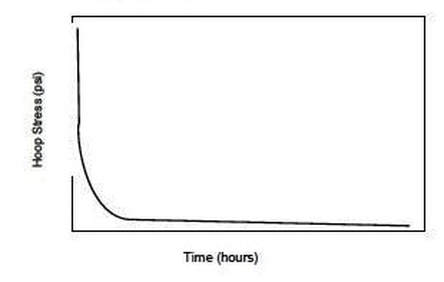
However, the data derived from the tests provide Cartesian coordinates where data do not form a straight line on a regular graph (Figure 1). 
Picture
Figure 1: Stree-Rupture date plotted on Cartesian coordinates
​Various detailed studies were performed to reach the best mathematical function that would convert the data to derive a linear graph or equation.

​Finally, the log- stress log- time linear equation was chosen for accurate and better results.

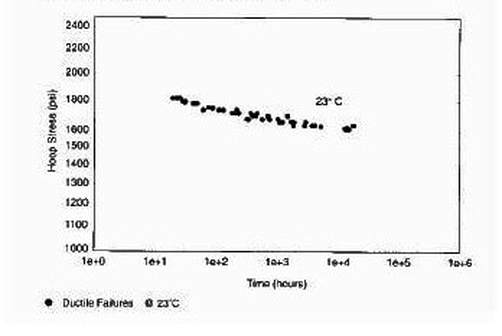
Following this model, when the time/ stress failure- point data is plotted on the log-log axes, it forms a straight line, which facilitates linear regression analysis (Figure 2).    
Picture
Figure 2: Hydrostatic Data in Linear Regression Method
​The conclusive stress rating for the piping materials can be deduced based on the Minimum Required-Strength (MRS) of the subjected material by evaluating the stress-rupture test data.   
Hydrostatic strength for thermoplastic materials
​The conclusive stress rating for the piping materials can be deduced based on the Minimum Required-Strength (MRS)

Testing methodology of ISO 9080   

ISO 9080 is a methodology that helps to determine the long-term hydrostatic strength of a thermoplastic material used for piping application by exploration.
​
This methodology tests thermoplastics material based on the principle to evaluate the material under constant stress in the pipe form.

​This also allows the evaluation of the stress rupture response of the materials under various stress loadings and durations for accuracy and better forecast.

A prediction of the long-term hydrostatic strength is extracted by using a linear regression model.   

The hydrostatic design stress (HDS) of a material is calculated based on the MRS derived from ISO 9080 / ISO 12162, which is categorized as the long-term hydrostatic strength (LTHS). 
"Hydrostatic design stress (HDS) of a material is calculated based on the MRS derived from ISO 9080 / ISO 12162, which is categorized as the long-term hydrostatic strength (LTHS)"
There is a listing done by the Plastics-Pipe Institute (PPI) for the materials’ MRS, which is TR-4.

This listing provided by PPI demonstrates MRS ratings for most thermoplastic piping materials.     

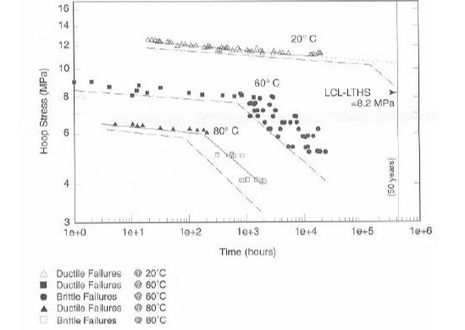
A possible knee in the stress rupture curve is extrapolated by ISO 9080 that falls before the 438, 000-hour or 50years intercept.

The knee in the regression curve categorically, with exceptions, reciprocates a change between the brittle (slit) failure and ductile failure modes in the polyolefin materials.  

The LTHS is inversely affected by temperature when subjected to thermoplastic materials, which means the LTHS is lower at a higher temperature for the same extrapolation time. ISO 9080 specifies test temperature to be 20C.  

The process of determination of long-term hydrostatic strength of the thermoplastic materials requires certain data for evaluation.

Data at two or three temperatures such as 20, 60 and 80C is required to determine the long-term hydrostatic strength of the thermoplastic materials.

The data required at each temperature are at least at 30 Failure points that is distributed over three log decades.

For each temperature, at least five different stress levels are required along with at least two specimens at each stress level.   

The procedure does not stipulate the number of material lots or the size of the pipes that need to be tested.

Further, to minimize the statistical scatter in the data, only one material lot is used to extract the data in the procedure.

Based on the statistical data and analysis an equation is established by the ISO 9080 to calculate the Lower-Prediction Limit (LPL) and the long-term hydrostatic strength (LTHS).   

Based on the statistical 97.5% LPL of the mean projection of the stress regression equation the LTHS is established by ISO 9080 to 50 years (438,000 hours).      
Picture

Derivation of MRS by statistically method ISO12162   

ISO 12162 specifies the method to classify the thermoplastics materials in pipe form and identify the material designation.

It also establishes a method for calculation of Minimum Required Strength (MRS).

A MRS for the material is established by the 97.5 % LPL LTHS which is derived from ISO 9080.    

The regression line is extrapolated to 50 years (438,000 hours), which is derived from 20C data.

​As illustrated in the Figure-3, the mean of LTHS for the material is the stress that is found in the 50- year (438,000 hours) intercept.
Picture
"MRS for the material is established by the 97.5 % LPL LTHS which is derived from ISO 9080.  The regression line is extrapolated to 50 years (438,000 hours), which is derived from 20C … the mean of LTHS for the material is the stress that is found in the 50- year (438,000 hours) intercept."


​TestLabs offer you the accredited ISO 9080 testing service

TestLabs laboratory is equipped with comprehensive testing facility to perform hydrostatic pressure testing to ISO 9080 for wide range of thermoplastic materials for pipe. Click here to find our more.

TestLabs are accredited laboratories that provide pipe and fittings testing to various types of pipe. These tests are conducted to ensure the systems tested are in compliance with international standards. Find out more about pipes tested by TestLabs.my.

With our accredited test report and certification, manufacturers can list with local authority and certification body in a more-timely manner. ​​


Comments are closed.

    Categories

    All
    Certification
    Environmental Test
    Test Equipment
    Testing

About us

​We are a network of experts in Malaysia, Singapore and across Asia,  specializing in products laboratory testing, ​ISO certification consulting and laboratory testing equipment. ​We serve the industries where quality and cost effectiveness are equally important - TestLabs.my

Quick links

  • Home
  • Testing
  • Testing Equipment
  • Certification
  • About Us 
  • Contact Us
  • Updates & Stories

Contact us

​Email : [email protected]
​
Phone : +6018-2030306
​​Address : Level 23-1, Premier Suite, One Mont Kiara, ​No 1, Jalan Kiara, Mont Kiara ​50480 Kuala Lumpur.
COPYRIGHT © 2025 SES Scientific Sdn. Bhd.